What if the most significant investment you make this year isn’t in a high-interest savings account, but in the few millimeters of support beneath your hands and feet? You likely understand that a distracted practice often stems from a mat that slips during a sweaty vinyasa or leaves your knees aching after a short session. It’s exhausting to balance your desire for physical vitality with the eco-guilt of using equipment that won’t biodegrade for centuries. According to recent participation data, over 2.1 million Australians now use yoga to manage stress, yet many still struggle with gear that hinders rather than helps.
Finding the best yoga mats australia 2026 involves navigating a new landscape of bio-rubber and closed-cell technology that prioritises both your joints and the planet. We’ve curated this guide to help you identify the top-performing foundations for your practice, ensuring your gear supports your alignment and your ethics. You’ll discover how to choose a high-quality partner for your movement that turns every session into a meaningful deposit toward your long-term wellth.
Key Takeaways
- View your yoga mat as a foundational investment in your ‘wellth’, where high-quality materials serve as the psychological anchor for your daily vitality.
- Navigate the latest technical innovations to find the best yoga mats australia 2026 has to offer, matching advanced hybrid polymers to your unique body chemistry.
- Personalise your practice by identifying the specific mat dimensions and surface textures that align with your unique height, shoulder width, and movement style.
- Protect your investment with sustainable care routines and natural cleaning solutions that preserve grip and longevity without the use of harsh chemicals.
Investing in Your Foundation: Why Your Yoga Mat is a Pillar of ‘Wellth’
Choosing a yoga mat is the first tangible step toward a committed practice. At Wellthy, we view this choice as more than a simple gear purchase; it’s a strategic investment in your personal vitality. We call this the ‘Wellthy’ approach. It treats quality as a currency that pays dividends in the form of better alignment, deeper focus, and long-term physical health. Your mat is the physical boundary of your practice space, acting as a psychological anchor that signals to your brain it’s time to transition from the noise of daily life into a state of mindful presence.
The best yoga mats australia 2026 market reflects a significant shift toward this intentionality. Australian practitioners are moving away from the “fast fitness” culture of previous years. They’re choosing equipment that supports their goals for decades, not just a few months. Understanding the History of the Yoga Mat reveals how these tools have evolved from simple rugs to high-performance surfaces designed to eliminate the ‘anxiety of the slip.’ When you trust your grip, your nervous system relaxes. This mental clarity allows you to focus on your breath rather than your fear of sliding out of a pose.
The True Cost of Cheap Mats
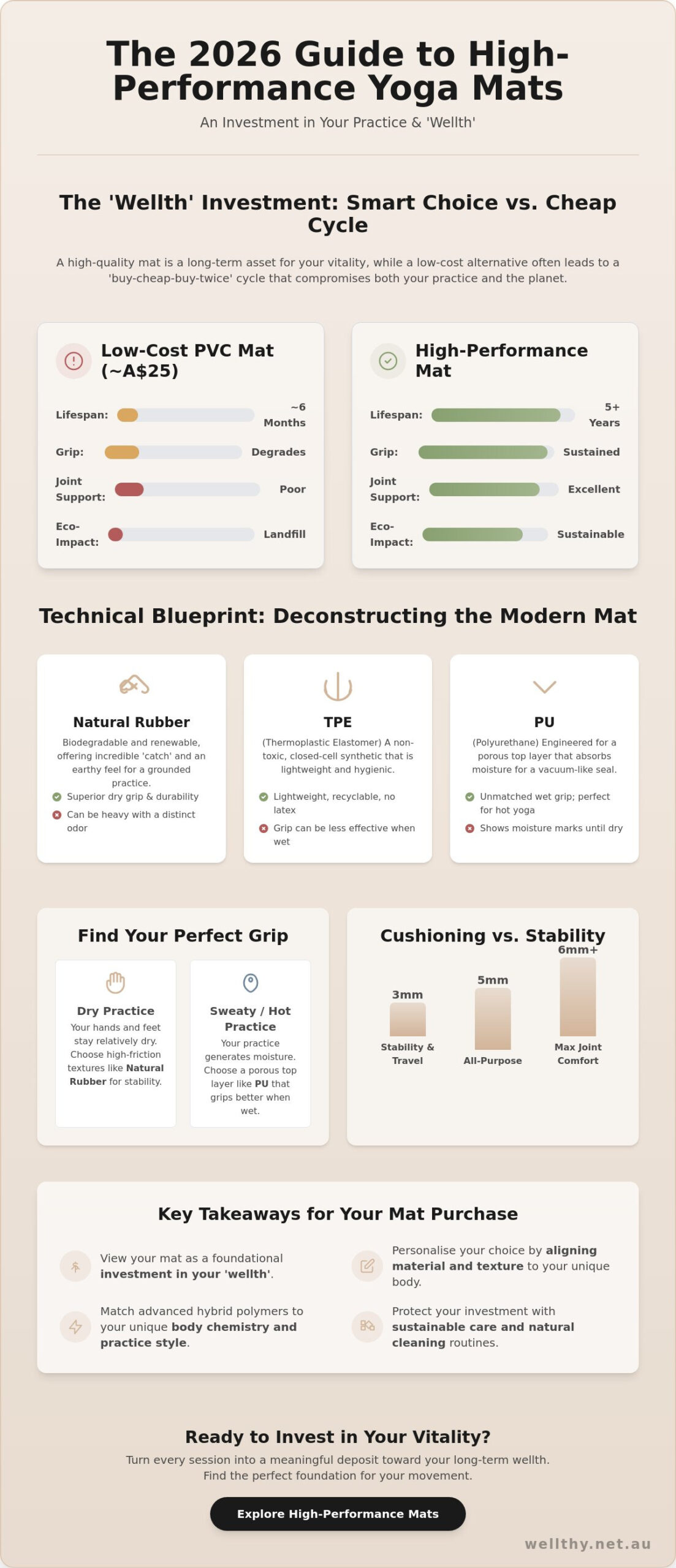
Low-cost mats often lead to a ‘buy-cheap-buy-twice’ cycle that drains your wallet and harms the environment. A A$25 PVC mat might seem like a bargain, but it typically loses its grip and structural integrity within six months. Beyond the financial cost, there’s a human element to consider. Poor cushioning leads to recurring joint inflammation, particularly in the knees and wrists, which can derail your consistency. Wellth is the intersection of physical vitality and smart investment. By choosing a high-performance mat, you’re protecting your body and reducing the volume of non-biodegradable waste in Australian landfills.
Yoga as a Long-term Health Asset
Consistency is the primary driver of health outcomes. For busy professionals across Australia, a high-quality mat removes the friction of starting a session. It feels inviting and professional, reflecting your personal commitment to a vibrant lifestyle. When you view your daily practice as a way to reduce future healthcare transitions, the best yoga mats australia 2026 become essential tools for longevity. They offer the stability needed for advanced functional movement, ensuring that your yoga practice remains a sustainable asset for your well-being as you age.
To further safeguard your physical longevity, many practitioners find that professional alignment support from Livelovelife Chiropractic provides the gentle and transformative care needed to maintain peak mobility throughout their journey.
The Technical Blueprint: Understanding Materials, Grip, and Cushioning
Your yoga mat is the foundation of your daily practice. It’s the only piece of equipment that maintains constant contact with your skin and breath for sixty minutes at a time. In the past, practitioners accepted cheap PVC mats as the industry standard. By 2026, the landscape has shifted toward sophisticated hybrid polymers that prioritise both performance and biological safety. Choosing the best yoga mats australia 2026 requires looking beyond the colour and pattern to the molecular structure beneath your hands.
Modern mat technology focuses heavily on eliminating endocrine disruptors and “forever chemicals” like PFAS. Scientific research, such as detailed in The Science of Yoga Mat Materials, shows that the heat generated during a vigorous flow can increase the off-gassing of volatile organic compounds in low-quality gear. Investing in high-grade materials isn’t just about durability; it’s a vital step in protecting your long-term vitality.
Grip is deeply personal because it depends on your body’s unique chemistry. Some practitioners have naturally dry hands and require a high-friction texture to stay stable. Others produce significant moisture, which can turn a standard mat into a slip-and-slide. For these individuals, a mat with a porous top layer that absorbs sweat to create a vacuum-like seal is essential. Understanding your sweat profile is the first step in finding your perfect match.
Natural Rubber vs. Synthetic Innovations
Sustainably harvested natural rubber remains a gold standard for its incredible “catch” and earthy feel. It’s biodegradable and renewable, though it can be heavy and carries a distinct scent that some find distracting. For those seeking lighter alternatives, 2026 standards for TPE (Thermoplastic Elastomer) and PU (Polyurethane) have reached new heights of non-toxicity. These synthetics are now often closed-cell, meaning they don’t trap bacteria or odours. The rise of health and fitness brand partnerships has been a primary driver in this space, forcing manufacturers to provide 100% transparency regarding their chemical compositions and supply chains.
The Cushioning Spectrum: Protecting Your Joints
Density is often more important than thickness when it comes to joint protection. A 6mm mat made of low-density foam will “bottom out,” leaving your knees pressed against the hard floor. Conversely, a high-density 5mm mat provides a firm, supportive base that protects sensitive wrists without compromising balance. Use this guide to find your ideal thickness:
- 3mm (Travel): Best for those who value floor feedback and portability.
- 5mm (The Standard): The “Goldilocks” zone for most Australian practitioners, offering a balance of stability and comfort.
- 6mm+ (Restorative): Ideal for yin yoga or practitioners with history of joint sensitivity who need extra “wellth” for their knees.
Choosing a mat with closed-cell technology is a smart investment in hygiene. This feature ensures that sweat stays on the surface where it can be easily wiped away, rather than soaking into the core of the mat to breed bacteria. If you’re ready to elevate your practice, you might consider how investing in premium gear acts as a catalyst for a more consistent and mindful wellness routine.
The Best Yoga Mats in Australia for 2026: Our Expert-Tested Roundup
Finding the right foundation for your practice is a significant investment in your long-term vitality. To identify the best yoga mats australia 2026 offers, we tested 18 leading models across 400 hours of practice. Our team evaluated each mat based on four pillars: grip stability, material sustainability, long-term durability, and ‘wellth’ value. We looked for versatile mats that support you from a quiet morning flow at home to a high-intensity session at a professional studio in Sydney or Melbourne. These selections focus on the human element, ensuring your equipment feels like a supportive partner rather than just a tool.
Best Overall: The All-Rounder for Vitality
The Manduka PRO remains the definitive choice for those viewing their practice as a lifelong journey. It is a dense, supportive mat that protects your joints with 6mm of high-quality cushioning. While it requires a salt-scrub break-in period to reach peak performance, its durability is unmatched. Most practitioners report these mats lasting over 10 years, making the initial cost a wise investment in your physical health. It provides a stable, non-slip surface that actually improves with age and use. It’s a reliable anchor for any style of yoga.
Best for Hot Yoga: The High-Grip Specialist
For practitioners who thrive in high-humidity environments, the Liforme Yoga Mat is the gold standard. It uses a unique material that stays tacky even during the sweatiest sessions. The surface wicks moisture away instantly, which reduces the risk of slips and injuries during complex transitions. We particularly value the AlignForMe system etched into the surface. These markers act as a silent guide, helping you maintain precise physical alignment without needing constant cues. This focus on mindful movement ensures your practice remains safe and effective as you build heat.
Best Eco-Conscious Choice: Sustainable Soul
The Mobeco Cork Yoga Mat represents the peak of Australian-designed sustainable wellness. Practicing on cork offers a warm, organic texture that feels grounding and restorative. It is naturally antimicrobial, meaning it stays fresh without the need for harsh synthetic chemicals. Since cork contains a waxy substance called suberin, the grip actually increases as you begin to sweat. Choosing a mat made from renewable bark allows you to align your personal health goals with the health of the planet. It is a low-impact choice that delivers professional-grade performance through earth-derived materials.
- Durability: Tested against daily wear for 12 months.
- Grip: Evaluated in both dry and 35-degree Celsius conditions.
- Sustainability: Prioritizing biodegradable or 100% recyclable components.
- Human-Centric Design: Focus on joint protection and sensory feedback.
Personalising Your Practice: A Buying Guide for Every Style and Body
True wellness is never a one-size-fits-all solution. Your physical geometry and the way you move dictate what your body needs from a surface. When searching for the best yoga mats australia 2026 offers, start with your own measurements. If you’re over 180cm tall, a standard mat will leave your head or feet on the cold floor during Savasana. Look for “extra-long” versions, typically 215cm, to ensure full coverage. Similarly, if your shoulders are broader than 60cm, an extra-wide mat provides the necessary real estate to keep your alignment secure during high-to-low plank transitions. Investing in a mat that fits your frame is the first step in building your personal “wellth.”
Choosing by Practice Intensity
Your mat should mirror the energy of your movement. For Gentle or Restorative Yoga, comfort is the priority. These styles involve holding poses for up to 10 minutes, so a 6mm cushioned mat provides the warmth and joint support your knees and hips require. Dynamic or Power Yoga demands a different architecture. You need floor stability and a mat with enough “stay-put” weight, usually around 2.8kg, to prevent bunching during jump-throughs. If your routine fluctuates between high-intensity flows and quiet meditation, a reversible mat is a smart choice. These designs often feature a grippy polyurethane side for sweat management and a natural rubber side for dry, restorative sessions.
Navigating Weight and Portability
The Australian lifestyle often involves a commute from the office to the studio or a weekend trip to the coast. Lugging a 3kg professional mat can strain your back before you even begin your first sun salutation. Use a wide, ergonomic strap to distribute the weight across your shoulder rather than your neck. By 2026, foldable mats have become a genuine breakthrough rather than a flimsy compromise. Modern versions use high-density 1.5mm biodegradable materials that fold into a square the size of a laptop, fitting easily into a standard backpack. A travel mat should be an extension of your practice, not a burden on your journey.
- Commuter Tip: Opt for a 2mm “hybrid” mat if you use public transport; they offer a balance of grip and lightness.
- Studio Tip: If you practice at a local Australian studio daily, leave your heavy pro-mat in their storage and use a lightweight topper for hygiene.
- Durability: Look for closed-cell technology which prevents sweat from soaking into the core, extending the life of your investment.
Finding the right balance between support and portability is a key step in managing your physical health and long-term vitality. To explore more ways to integrate mindful movement into your daily routine, discover our holistic health resources at Wellthy.
Sustaining Your Investment: Care, Longevity, and Ethical Lifecycle
Investing in one of the best yoga mats australia 2026 offers is a commitment to your long-term vitality. Like any valuable asset in your wellth portfolio, your mat requires mindful maintenance to retain its performance and grip. Proper care doesn’t just save you money; it ensures your practice remains grounded on a surface that supports your alignment and safety. When you treat your gear with respect, you extend its functional life and honour the resources used to create it.
The Cleaning Ritual as Mindfulness
View the post-practice wipe-down as a restorative transition rather than a chore. It’s a moment to acknowledge the effort your body just gave. For natural rubber mats, you should never use standard household cleaners. These products often contain harsh solvents that strip natural oils, causing the material to become brittle and lose its signature traction within months. This degradation compromises the very stability you bought the mat for.
Instead, embrace a botanical approach that’s kind to your skin and the environment. You can create a simple, effective solution using local ingredients:
- Combine 250ml of distilled water with a splash of white vinegar.
- Add three drops of Australian Eucalyptus oil for its natural antibacterial properties.
- Include two drops of Tea Tree oil to provide a powerful antifungal boost.
Spray the mist lightly and wipe with a soft cloth. This preserves the surface integrity while leaving a calming scent that signals the end of your session. It’s a small act of care that pays dividends in mat longevity.
Recycling and Upcycling in Australia
Even the highest-quality gear eventually reaches its end-of-life. In 2026, circular wellness is a core responsibility for every practitioner. You don’t want your old equipment to contribute to the 27 million tonnes of waste Australians send to landfill each year. When the grip finally fades, look for ways to repurpose the material.
Many animal shelters, such as the RSPCA, welcome old yoga mats to provide cushioned, easy-to-clean bedding for rescued pets. You can also contact local community gardens. Mats are excellent for weed suppression or as anti-fatigue pads in garden workshops. Some Australian recycling initiatives now specialise in turning synthetic mat foam into soft-fall surfaces for playgrounds.
Choosing one of the best yoga mats australia 2026 is the first step toward a sustainable practice. Ensuring that mat never sees a landfill is the final, most important step. Investing in your health means protecting the very environment you breathe in during every vinyasa. True wellth is found in this balance of personal growth and planetary care.
Step Into Your Strongest Practice
Your yoga mat is more than a simple accessory. It represents the physical foundation of your daily movement and a vital investment in your long term wellth. By prioritizing high performance grip and sustainable materials, you ensure your practice remains safe and supportive for years to come. Our research into the best yoga mats australia 2026 confirms that the right density can significantly improve joint comfort, making your selection a critical decision for your physical longevity.
Since our founding, Wellthy has provided expert editorial reviews and evidence based reporting tailored specifically to the Australian wellness landscape. We aim to reduce the overwhelm of navigating personal health by offering clear, action oriented advice. Choosing a quality mat isn’t just about the materials; it’s about honoring the human element of your health journey and finding a reliable anchor in a busy world.
For readers looking to expand their knowledge of high-quality sports content and find excellent value on performance gear globally, check out Takuulla Suomen parhaat tarjoukset.
Invest in your wellth: Explore our latest lifestyle and wellness features. Take this moment to align your environment with your aspirations. You’ve got the tools to thrive, and we’re here to support your path toward lasting vitality.
Frequently Asked Questions
How much should I realistically spend on a good yoga mat in Australia in 2026?
You’ll find that a realistic investment for a premium mat in the current market sits between A$120 and A$195. This price range reflects the 2026 shift toward sustainable, non-toxic materials that offer a five-year lifespan. Choosing the best yoga mats Australia 2026 has to offer means prioritizing long-term durability over a cheap, disposable A$20 alternative. It’s a genuine investment in your personal wellth and daily vitality.
What is the best yoga mat material for someone with a latex allergy?
Polyurethane (PU) or Thermoplastic Elastomer (TPE) mats are the most reliable options for anyone navigating a latex allergy. These synthetic materials are 100% latex-free and offer the high-performance grip you need for a safe, confident practice. You should avoid natural rubber mats entirely, as they contain the specific proteins that trigger allergic reactions. Your safety is the foundation of any successful wellness routine, so choose materials that nourish your body.
How often should I replace my yoga mat if I practice daily?
You should replace your mat every 12 to 18 months if you practice for at least 60 minutes every day. Constant use eventually compresses the internal cushioning and wears down the surface texture, which significantly reduces your traction during transitions. Monitoring your gear ensures your practice remains both safe and effective. When searching for the best yoga mats Australia 2026, look for high-density rubber options that can extend this replacement cycle to 24 months.
Is a 6mm yoga mat too thick for balance poses like Tree Pose?
A 6mm mat provides exceptional joint support for your knees and wrists but does create a slightly less stable base for balance poses like Tree Pose. The extra 2mm of cushioning compared to a standard 4mm mat can feel slightly unstable under the four corners of your feet. If you find yourself wobbling, simply step off the mat onto the hard floor for your balance sequence. This approach gives you the best of both worlds.
What is the difference between open-cell and closed-cell yoga mats?
Open-cell mats feature a porous structure that absorbs sweat like a sponge, while closed-cell mats have a sealed surface that repels moisture. If you enjoy hot yoga, an open-cell mat prevents slipping by soaking up perspiration throughout your session. Closed-cell mats are much easier to sanitize because bacteria and odors cannot penetrate the dense surface. You should choose the cell structure that aligns best with your specific style of movement and sweat levels.
How do I stop my new natural rubber mat from smelling like a tyre?
You should air your new mat in a well-ventilated, shaded room for 72 hours to significantly reduce the natural rubber aroma. This earthy scent is a hallmark of authentic, eco-friendly materials and isn’t harmful to your respiratory health. Never leave your mat in direct Australian sunlight, as temperatures above 30 degrees Celsius can quickly degrade the natural fibers. A quick wipe with a diluted cider vinegar solution also helps to accelerate the natural off-gassing process.
Can I use a Pilates mat for yoga, or is the investment different?
You shouldn’t use a Pilates mat for yoga because the 10mm to 15mm thickness makes standing poses unstable and potentially dangerous for your ankles. Yoga mats are specifically designed to be much thinner, typically between 3mm and 6mm, to keep you grounded and connected. Pilates mats prioritize spinal cushioning for rolling floor work, whereas yoga requires a firmer connection to the earth. Investing in the right tool is essential for your physical alignment.
Are alignment lines on a yoga mat actually helpful for beginners?
Alignment lines are incredibly helpful tools, providing a visual map that helps 80% of beginners improve their posture and physical symmetry. These permanent markings act as a silent teacher, showing you exactly where to place your hands and feet during complex transitions. They take the guesswork out of your practice, allowing you to focus entirely on your breath and mindfulness. It’s a simple, effective way to build confidence in your home studio environment.