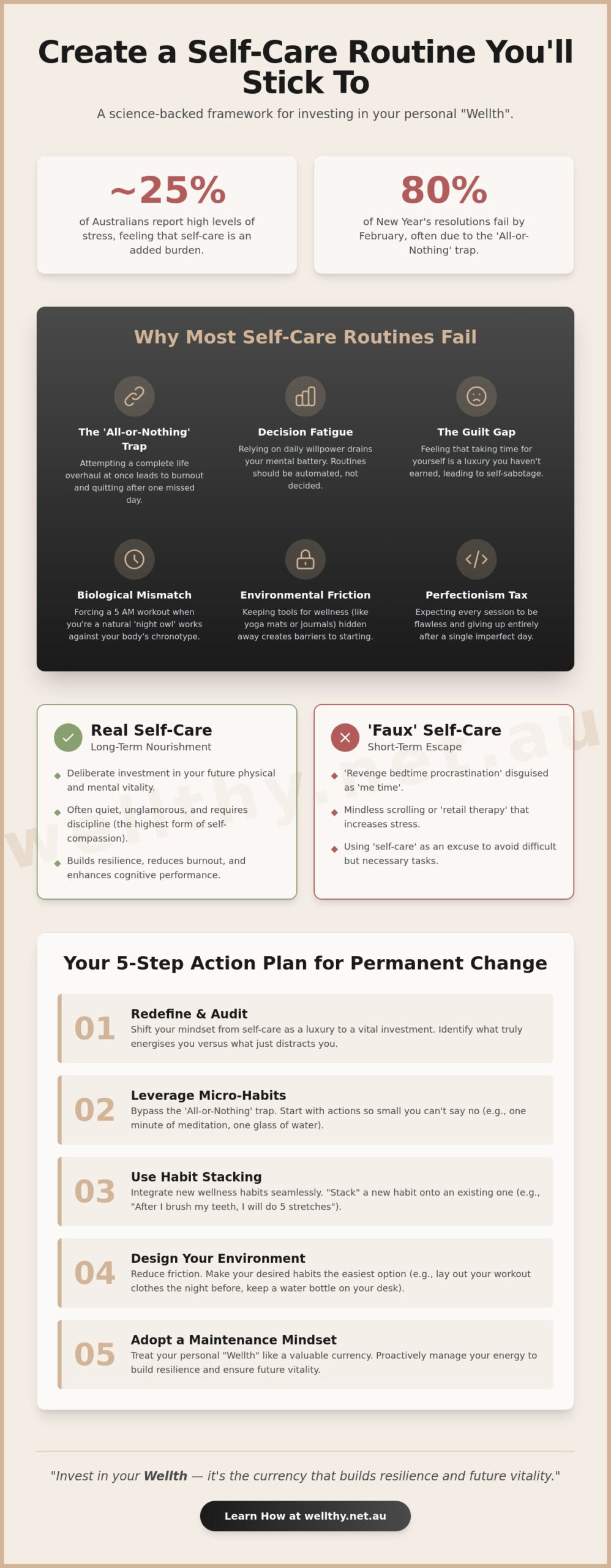
What if the secret to lasting vitality isn’t found in a 15-step skincare ritual or an expensive retreat, but in the small, quiet moments you actually enjoy? A 2023 report from the Australian Psychological Society noted that nearly 25% of Australians report high levels of stress, yet most self-care attempts fail because they feel like an added burden. If you’re tired of starting strong only to quit by Wednesday, learning how to create a self-care routine you’ll stick to requires moving past the aesthetic social media trends that feel unattainable. You deserve a strategy that respects your time and your unique energy levels.
It’s natural to feel a sense of guilt when you finally prioritise yourself, especially when your to-do list feels endless. We believe that true wellness shouldn’t feel like a chore or a luxury you haven’t earned. This guide provides a science-backed, sustainable framework to transform self-care into a permanent investment in your personal wellth. We will explore the neurobiology of habit formation and the practical steps to reduce mental clutter, helping you build a routine that feels like a natural part of your day in 2026 and beyond.
Key Takeaways
- Redefine self-care as a deliberate investment in your vitality rather than a fleeting luxury, ensuring your rituals align with your long-term health goals.
- Understand the science of sustainability to bypass the “all-or-nothing” trap and decision fatigue that often derail new wellness habits.
- Discover how to create a self-care routine you’ll stick to by using a bespoke framework that prioritises foundational needs across physical, mental, and social pillars.
- Master the 5-step action plan for permanent change, leveraging micro-habits and habit stacking to integrate wellness seamlessly into your Australian lifestyle.
- Shift toward a proactive maintenance mindset, treating your personal “wellth” as a valuable currency that builds resilience and future vitality.
Redefining Self-Care: Why It’s Your Greatest Personal Investment
Forget the curated aesthetic of luxury spas and A$300 facial serums that dominate social media feeds. While these moments of indulgence have their place, they don’t capture the true essence of sustainable health. In 2026, we must look deeper. Self-care isn’t a reward you earn after a long week; it’s the foundational fuel that allows you to work, love, and live with intention. It’s a deliberate practice of investing in your physical and mental vitality to ensure you aren’t running on empty.
According to this comprehensive definition of self-care, the practice involves any necessary human regulatory function which is under individual control, deliberate, and self-initiated. We view this as a strategic partnership with your future self. You’re acting as a Wise Guide for the person you’ll be in five or ten years, ensuring they inherit a body and mind that are thriving rather than merely surviving. At Wellthy, we believe your health is a currency more valuable than any bank balance. We call this ‘Wellth’. When you learn how to create a self-care routine you’ll stick to, you’re not just checking boxes; you’re managing your most precious resource.
The Difference Between Self-Care and Self-Indulgence
Real self-care provides long-term nourishment, while indulgence offers a short-term escape. Self-care is often quiet, unglamorous, and requires a level of discipline that many mistake for a chore. However, this discipline is actually the highest form of self-compassion. It’s the choice to do what’s best for your long-term vitality rather than what feels easiest in the moment. You should be wary of ‘faux self-care’ activities that leave you feeling more drained, such as:
- Revenge bedtime procrastination disguised as ‘me time’.
- Mindless scrolling through wellness influencers for hours.
- Over-spending on ‘retail therapy’ that creates financial stress.
- Using ‘self-care’ as an excuse to avoid necessary difficult conversations.
The ROI of Wellbeing in 2026
The financial and personal logic of a solid routine is clear. Consistent habits significantly reduce the long-term ‘cost’ of burnout and complex healthcare transitions. A 2024 report by Deloitte Australia indicated that mental ill-health costs the Australian economy up to A$70 billion annually in lost productivity. By prioritizing your personal vitality, you directly enhance your professional performance and cognitive resilience. Understanding how to create a self-care routine you’ll stick to acts as an insurance policy for your quality of life.
The Science of Sustainability: Why Most Routines Fail
Learning how to create a self-care routine you’ll stick to requires looking at the biology of habit, not just willpower. Most people fail because they fall into the ‘All-or-Nothing’ trap. They attempt to overhaul their entire life on a Monday, only to burn out by Wednesday. Research indicates that 80 percent of New Year’s resolutions fail by the second week of February because they lack incremental scaling. Your brain craves consistency over intensity. When you start too big, your amygdala senses a threat to your established comfort zone, triggering a resistance response that makes even simple tasks feel Herculean.
Decision fatigue is another silent routine killer. Humans make roughly 35,000 choices every day. If your self-care requires a fresh decision every morning, you’re draining your mental battery before you’ve even laced up your trainers. Structure removes this friction. When your routine is pre-decided, it becomes an automated investment in your personal wellth. This alignment helps bridge the ‘Guilt Gap,’ that nagging feeling that taking time for yourself is a luxury you haven’t earned. In reality, self-care is the fundamental fuel that makes your professional and personal contributions possible.
To avoid these common hurdles, it helps to identify the specific friction points in your current approach:
- The Perfectionism Tax: Expecting every day to be flawless and quitting after one missed session.
- Environmental Friction: Keeping your tools for wellness, like a yoga mat or journal, hidden away in a cupboard.
- Biological Mismatch: Forcing a 5 AM workout when your natural chronotype is a ‘night owl,’ which ignores the 2017 Nobel Prize-winning research on circadian rhythms.
Understanding the Cortisol-Stress Loop
Chronic stress puts your nervous system into a ‘tired but wired’ state. In this survival mode, your brain often views rest as a threat rather than a recovery tool. You might find yourself doom-scrolling instead of sleeping because your body is stuck in a high-cortisol loop. True vitality begins with maintaining your mental health through nervous system regulation. If your body doesn’t feel safe, it will reject new habits as unnecessary distractions. Understanding how to create a self-care routine you’ll stick to involves teaching your body that it’s safe to slow down.
Common Pitfalls in Australian Lifestyle Design
In Australia, we often over-schedule our wellness until it feels like a second job. We try to fit a coastal sunrise walk, a HIIT session, and complex meal prep into a single morning. This neglects the human element. You aren’t a productivity machine; you’re a person who needs genuine nourishment. Comparing your messy ‘behind-the-scenes’ to a curated Instagram highlight reel only deepens the sense of failure. Real health is about finding a sustainable rhythm that respects your unique circumstances. If you’re struggling to find that balance, building a personalized support system can help you bridge the gap between intent and action.
A Framework for Building Your Bespoke Self-Care Routine
Building a sustainable routine isn’t about mimicking a celebrity’s 4:00 AM ice bath. It’s about alignment. To understand how to create a self-care routine you’ll stick to, you must first audit your current energy leaks. Many Australians report high levels of exhaustion; a 2024 study by the University of Melbourne found that 46% of workers feel consistently burnt out. Identifying where your energy vanishes, such as notification fatigue or a lack of boundaries after 5:00 PM, is the first step toward reclaiming your vitality. You cannot pour from an empty cup, and you certainly cannot build a routine on a foundation of depletion.
Categorise your needs into four essential pillars: Physical, Mental, Emotional, and Social. Your career demands in cities like Sydney or Brisbane might require more mental decompression, while a physically demanding role requires more physiological recovery. We view this as an investment in your personal “wellth.” By diversifying your self-care across these pillars, you ensure that your health remains a resilient asset rather than a fleeting goal.
The Hierarchy of Self-Care Needs
Think of your routine as a building. You wouldn’t install a chandelier before the floorboards are laid. Level 1 consists of your non-negotiables: quality sleep, consistent hydration, and basic movement. Level 2 moves into emotional regulation through journaling or setting firm boundaries. Finally, Level 3 focuses on elevated vitality, such as professional development or community engagement. If you’re struggling with how to create a self-care routine you’ll stick to, it’s often because you’re prioritising Level 3 rituals while Level 1 is crumbling.
| Foundational Needs (The Floor) | Elevated Rituals (The Chandelier) |
|---|---|
| 7-9 hours of restorative sleep | A complex 10-step skincare routine |
| Drinking 2L of filtered water daily | Monthly boutique wellness retreats |
| Nutritious, whole-food nourishment | Advanced biohacking or infrared saunas |
Personalized Support: Finding Your ‘Wellness Anchors’
Your wellness anchors are the two or three activities that consistently make you feel grounded, regardless of the chaos surrounding you. These are your “minimum viable” actions for high-stress days. When your schedule tightens, you don’t abandon your routine; you revert to your anchors. For some, it’s a ten-minute walk in the local park; for others, it’s a morning cup of tea without a screen in sight. These anchors act as a reliable bridge between your busiest seasons and your periods of rest.
Integrating holistic health doesn’t require a clinical environment or expensive equipment. It requires a commitment to the human element of your health. By choosing anchors that resonate with your unique life stage, you create a sense of calm reassurance. This approach moves you away from the “all or nothing” mindset that causes most routines to fail by the second week of February. Instead, you develop a restorative rhythm that evolves alongside you.
The 5-Step Action Plan to Make Self-Care Permanent
Sustainable wellness is an investment in your future vitality. To learn how to create a self-care routine you’ll stick to, you must move beyond fleeting inspiration and into habit infrastructure. This five-step framework transforms intentions into permanent lifestyle pillars, ensuring your health becomes your greatest form of “wellth.”
- Step 1: Start Micro. Commit to the five-minute habit. Whether it’s deep breathing or a quick stretch, the goal is showing up. Small wins build the psychological momentum needed for larger shifts.
- Step 2: Habit Stacking. Attach your new ritual to an existing anchor. This uses established neural pathways to trigger new behaviours effortlessly.
- Step 3: Environment Design. Audit your surroundings. If your goal is hydration, place a glass of water on your bedside table tonight. Make the healthy choice the path of least resistance.
- Step 4: The 2-Day Rule. Life is unpredictable. You can miss one day, but never miss two. This prevents a single lapse from becoming a total collapse of your progress.
- Step 5: Review and Realign. Every 30 days, assess your progress. Your routine should be agile, evolving as your personal and professional seasons change.
Mastering Habit Stacking for Busy Professionals
Efficiency is the currency of the modern professional. Habit stacking works because it leverages neuroplasticity, the brain’s ability to reorganise itself by forming new connections. Instead of relying on memory, you use a “trigger” to automate the process. For example, “After I pour my morning coffee, I will write three gratitudes.” The coffee is the anchor; the gratitude is the growth. This method reduces cognitive load, making your self-care feel like a natural extension of your day rather than an added chore on a crowded to-do list.
Designing Your Space for Success
Your environment dictates your behaviour. Designing your physical space is a critical component of how to create a self-care routine you’ll stick to throughout 2026. To reduce friction, set out your gym clothes or your journaling tools the night before. This simple act removes the decisional fatigue that often leads to procrastination.
Australians have a unique “outdoor advantage” that provides a natural routine enhancer. Use our abundance of morning light and local coastal tracks to anchor your movement. A 10-minute walk at sunrise provides the Vitamin D and cortisol regulation necessary for long-term health. Finally, protect your digital boundaries. Keep your phone out of the bedroom to ensure your evening ritual remains a sacred space for restoration.
Investing in Your Future Self: The Wellthy Approach
True vitality isn’t found in a frantic, one-off detox or a temporary fitness surge. It lives in the quiet, daily choices that build your wellth over time. Shifting your perspective from a fix-it mindset to a maintenance mindset is the secret to longevity. Most traditional health models are reactive, waiting for a breakdown before offering a solution. We believe in a proactive approach. Think of your body and mind like a high-performance vehicle; you don’t wait for the engine to seize before checking the oil. Regular, rhythmic care prevents the high cost of emergency repairs later in life. This is the essence of building sustainable wellth.
At Wellthy, we understand that finding the right tools is half the battle. We bridge the gap between complex health science and your daily life through evidence-based brand partnerships. Whether it’s advanced nutrition, specialized intimate wellness solutions from Velobiotics, or eco-friendly personal care tools from resetrazor.au, we’ve done the heavy lifting to curate resources that actually work, ensuring your routine is built on a foundation of integrity and proven results. Beyond the tools, we champion the concept of social wellth. Research from the Australian Institute of Health and Welfare suggests that strong social connections are linked to better physical and mental health outcomes. You aren’t just building a habit; you’re joining a movement of like-minded Australians committed to thriving together. Your health is the only asset that pays dividends forever, and we’re here to help you manage it with confidence.
Navigating Health Transitions with Confidence
Life doesn’t stand still. Whether you’re switching careers, moving house, or managing a new life stage, these shifts can easily derail your progress. A solid routine acts as your anchor during these storms, providing a sense of control when everything else feels fluid. Understanding how to create a self-care routine you’ll stick to provides a reliable framework that adapts as you do. Our personalized support helps you adjust your sails without losing momentum. You can explore our Health and Fitness Brand Partnerships to discover curated wellness tools designed to evolve alongside your changing needs and goals.
Your Next Steps to a Sustainable Lifestyle
The path to a vibrant life begins with a single, manageable action. Start by drafting your Version 1.0 routine today. It doesn’t need to be perfect; it just needs to be present. Focus on one or two small habits that feel achievable even on your busiest days. We invite you to join the Wellthy community for ongoing inspiration and expert guidance from our team of care coordinators. Mastering how to create a self-care routine you’ll stick to is a journey of small, deliberate wins rather than overnight transformations. Start small, stay consistent, and watch your wellth grow.
Invest in Your Most Valuable Asset Today
Building a life of vitality requires more than a fleeting interest in wellness; it demands a shift toward viewing your health as “wellth.” By moving past the 80% failure rate often seen in traditional resolutions, you’ve now gained the evidence-based wellness strategies needed to align your daily actions with your long-term goals. You understand that a bespoke framework, rather than a generic checklist, is the key to lasting change. This is the foundation of a resilient lifestyle.
Mastering how to create a self-care routine you’ll stick to means prioritizing small, science-backed wins that compound over time. As an expert-led Australian lifestyle publication trusted by leading health and fitness brands, we provide the clarity needed to navigate your personal health transitions. This 5-step action plan is your roadmap to a more vibrant 2026. You have the tools to turn your personal well-being into your greatest investment. Your future self is already reaping the rewards of the choices you make this afternoon.
Discover more ways to invest in your wellth on our homepage
The path to a balanced lifestyle is yours to walk, and we’re here to support every step of your transformation.
Frequently Asked Questions
How long does it actually take for a self-care routine to become a habit?
It takes an average of 66 days for a new behavior to become automatic, according to a landmark study by University College London researchers. While some people form habits in just 18 days, others require up to 254 days. Patience is your greatest asset during this transition. Focus on consistency rather than perfection. Your brain needs this time to build the neural pathways that make your routine feel like a natural part of your day.
Can I have a self-care routine if I have zero spare time in my day?
You can absolutely maintain a routine by integrating micro-moments that take less than 5 minutes. True wellness doesn’t require hour-long sessions to be effective. Try a 2 minute breathing exercise while the kettle boils or a 3 minute stretching sequence during your lunch break. Learning how to create a self-care routine you’ll stick to often starts with these tiny, manageable investments in your personal wellth.
What are the best free self-care activities for Australians?
Australia offers incredible free resources like the 10,000 plus public beaches and extensive national park networks for forest bathing. You can also access free mindfulness apps like Smiling Mind, which was developed in Melbourne for local needs. Walking for 30 minutes in a local green space can lower cortisol levels by 15 percent. These activities provide high-impact nourishment for your soul without costing a single cent.
Is it okay to change my self-care routine frequently?
Yes, your routine should evolve as your life circumstances and the Australian seasons change. A 2023 wellness survey found that 62 percent of people adjust their habits every three months to stay motivated. Flexibility is a sign of a healthy, sustainable practice. If a morning swim in July feels too cold, swap it for a warm yoga flow indoors. Listen to what your body needs in the present moment.
How do I deal with the guilt of taking time for myself?
Reframe self-care as a necessary investment in your capacity to care for others. Think of it like an airline safety briefing where you must secure your own oxygen mask first. When you prioritize your vitality, you show up more effectively for your family and work. Research suggests that employees who take regular breaks are 13 percent more productive. Taking time isn’t selfish; it’s essential for your long-term sustainability.
What should I do if I fall off my routine for a week or more?
Simply resume your practice at the next available opportunity without judging your past performance. Perfection is the enemy of progress. If you’ve missed 7 days, don’t try to make up for lost time with a 4 hour session. Start small with one 10 minute activity today. This resilient, non-judgmental approach is key when learning how to create a self-care routine you’ll stick to over the long term.
How do I know if my self-care routine is actually working?
Look for objective markers like improved sleep quality or a 10 percent increase in your daily energy levels. You might notice you’re reacting more calmly to stress at work or feeling less drained by 3:00 PM. Keep a simple log for 21 days to track these subtle shifts in your mood and vitality. When your routine is working, you’ll feel a sense of alignment and quiet confidence in your daily life.