
Your tabs are still open at 9:30 pm. Slack hasn’t stopped. You’re tired but wired, hungry but not sure what for, and the idea of “just relax” feels faintly insulting. That’s where a lot of Australians are sitting right now. Stress isn’t only a rough week anymore. For many people, it’s become the background setting.
That matters because a supplement for stress can help, but only when it’s chosen for the right job. Some options are better for a racing mind. Some are better for the physiological cortisol load that leaves you flat, foggy, and snappy. Some are useful. Some are overhyped. And some are a bad fit if you’re taking regular medication.
I prefer a more useful frame. Don’t treat supplements like a rescue remedy. Treat them like part of your long-term wellth strategy. The goal isn’t to numb out or push harder. It’s to build a steadier nervous system, protect energy, and make good decisions consistently.
Table of Contents
- Feeling Stretched Thin in 2026
- How Chronic Stress Rewires Your Body
- Evidence-Based Supplements for Stress Management
- Navigating Supplement Safety and Medication Interactions
- How to Choose a Quality Supplement in Australia
- Supplements Are a Piece of a Larger Puzzle
- Building Your Sustainable Strategy for Calm
Feeling Stretched Thin in 2026
A typical stress pattern now looks deceptively normal. You get through work, answer messages late, scroll to switch off, sleep lightly, wake unrefreshed, then rely on caffeine and momentum to do it again. Plenty of high-functioning people look fine from the outside while their system is running hot.
That sense of overload is common, but it shouldn’t be normalised. 1 in 5 Australian adults report they experience anxiety on a daily basis, according to 2024 data referenced here. If that sounds familiar, you’re not weak, and you’re not failing at life. Your load may be exceeding your recovery capacity.
For some people, the next right step is not a supplement. It’s a conversation, proper assessment, and support from a mental health professional. If you’ve been circling that decision, this guide to finding the right therapist is a useful way to think through fit, approach, and what to ask before booking.
For everyone else, the practical question is this. How do you reduce the strain before it becomes your baseline? A good place to start is tightening the basics of workload, boundaries, and recovery. Wellthy’s article on how to reduce stress from work and reclaim your vitality is a solid companion to the supplement side of the conversation.
Supplements work best when they support an organised routine. They work poorly when they’re expected to compensate for a life with no recovery built into it.
That’s the lens worth keeping. A supplement for stress can be smart, evidence-informed, and helpful. It just needs to sit inside a bigger plan.
How Chronic Stress Rewires Your Body
Chronic stress changes more than mood. It alters sleep architecture, appetite signals, immune activity, blood sugar regulation, muscle recovery, and the way the nervous system judges what is safe. Over time, that can look less like a single “stress problem” and more like a collection of frustrating symptoms that seem unrelated.
In Australia, psychological distress remains high enough to be a public health concern, with national reporting from the Australian Bureau of Statistics National Study of Mental Health and Wellbeing showing how common significant mental strain has become. In clinic, the pattern is familiar. People say they are tired all day, then alert at night, flat in the gym, short with family, and unsettled in the gut.
When the alarm never switches off
The HPA axis, short for hypothalamic-pituitary-adrenal axis, coordinates a big part of the body’s stress response. The brain registers pressure or threat, signals the adrenal glands, and stress hormones such as cortisol and adrenaline rise. In the short term, that response is useful. Attention sharpens, glucose becomes more available, and the body shifts resources toward immediate survival.
Problems start when that response becomes frequent and persistent.
At that point, the body stops treating stress as a short event. It starts adapting to it as a background condition. Cortisol rhythms can flatten, sleep can become lighter, and the nervous system can become more reactive to minor triggers. That is one reason a normal inbox, a small conflict, or one poor night of sleep can suddenly feel disproportionate.
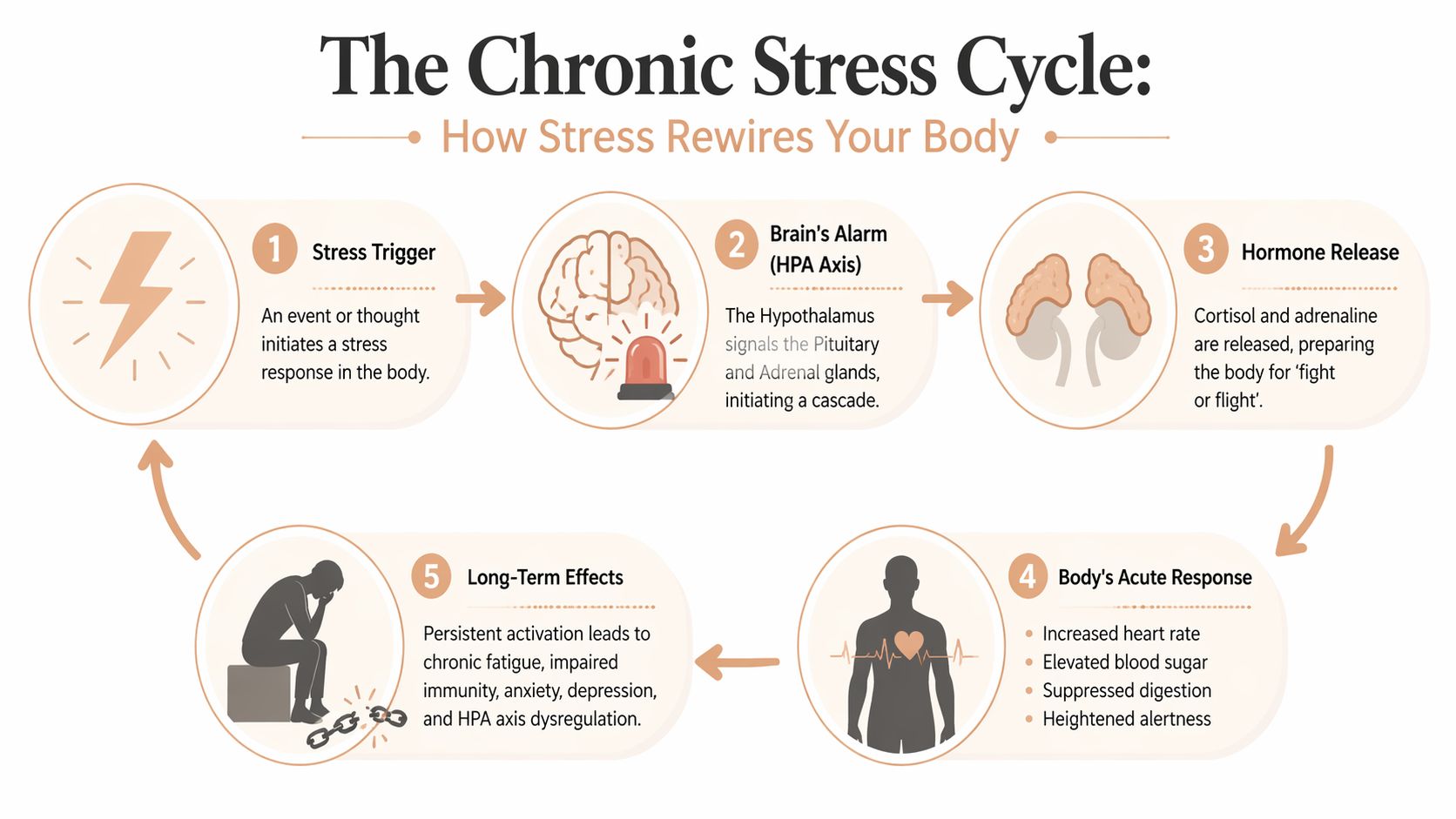
This matters in 2026 because many adults are carrying layered stressors at once. Work intensity, financial pressure, poor sleep habits, heavy training loads, alcohol, shift work, parenting strain, and constant device exposure all push on the same biology. A supplement can support that system, but it cannot fully override a lifestyle that keeps re-triggering it.
What elevated stress chemistry feels like day to day
Chronic stress rarely presents as one neat symptom. It usually shows up as a recognisable cluster.
- Sleep gets lighter: you may fall asleep from exhaustion, then wake at 3 am, wake often, or feel unrefreshed.
- Digestion becomes unpredictable: bloating, appetite swings, nausea, altered bowel habits, and a “tight” stomach are common.
- Mental performance drops: concentration takes more effort, memory feels less reliable, and small decisions feel heavier.
- Recovery slows: exercise, work pressure, and social demands all seem to cost more than they used to.
- Tolerance narrows: noise, interruptions, and minor setbacks trigger a bigger reaction than your usual baseline.
Many people read that as poor discipline or lack of resilience. Clinically, it often reflects a nervous system that has not had enough consistent cues of safety, rest, and recovery.
The gut-brain link is part of that picture. Stress can change motility, gut permeability, and microbial balance, which then feeds back into mood, cognition, and inflammation. If that pattern sounds familiar, this article on gut health and mental clarity and the science of your second brain adds useful context.
Practical rule: If stress is affecting sleep, digestion, focus, and irritability at the same time, treat it as a system-level issue first.
That principle also helps with supplement decisions. Products marketed as stress relief supplements can be useful, but the right choice depends on the pattern underneath, your medication list, and whether the goal is calmer focus, better sleep, or improved resilience over time.
Evidence-Based Supplements for Stress Management
By the time many clients ask about supplements, the pattern is already familiar. They are holding it together at work, sleeping lightly, snapping more easily than usual, and scanning shelves full of “calm” formulas that bundle half a dozen ingredients in token doses.
A better filter is simpler. Match the supplement to the job you need it to do. For stress, that usually means choosing between support for physiological stress load, calm focus under pressure, or a more basic correction for an under-recovered system.
Ashwagandha for physiological stress load
Ashwagandha remains one of the more credible herbal options for people with ongoing, body-level stress. Its withanolides appear to influence stress signalling pathways and may help reduce the sense of being constantly switched on.
A systematic review and meta-analysis in BJPsych Open found improvements in anxiety and stress-related measures across clinical trials, with some studies also reporting lower cortisol. That makes ashwagandha more relevant for cumulative stress than for a same-day “take the edge off” effect before a hard meeting.
In clinic, the best-fit presentation is fairly consistent. The person feels wired, flat, tense, and slower to recover after ordinary demands. Sleep may be lighter, but the core issue is often daytime overactivation rather than simple insomnia.
Trade-offs matter here:
- Best fit: persistent stress load, tension, poor recovery, stress-related sleep disruption
- Less useful for: people expecting a noticeable effect within a few hours
- Clinical caution: it can be effective and still be the wrong choice if there is thyroid disease, autoimmune history, pregnancy, or medication complexity
Typical doses used in trials often sit around 225 to 600 mg/day, depending on the extract and withanolide standardisation. That dose range is one reason cheap multi-ingredient blends often disappoint. They rarely include enough of any one herb to do much.
L-theanine for calm focus
L-theanine suits a different stress pattern. It is often the cleaner option for people who need composure without sedation. That includes deadline-heavy office work, public speaking, study, parenting under load, and the late-afternoon state where the body feels tight but the brain still needs to perform.
A 2024 randomised controlled trial published in Nutrients examined L-theanine in adults with moderate stress and reported improvements in stress-related outcomes and sleep measures compared with placebo. Earlier human research has also linked L-theanine with relaxation-related alpha brain wave activity, which fits the “calm but still functional” effect many people notice.
That distinction is useful in practice. L-theanine does not usually flatten alertness. It tends to reduce friction while preserving clarity.
L-theanine is often the better choice for people who say, “I need to stay switched on, just less tense.”
Practical use usually falls into two categories:
- Daily support: for background tension, mental overstimulation, and poor-quality sleep
- Situational support: before known stressors when steadiness matters more than sedation
Common trial doses include 200 mg/day and 400 mg/day, depending on whether the goal is acute calm focus or a structured trial over several weeks. If sleep disruption is part of the picture, this guide to sleep supplements available in Australia gives useful context on where L-theanine may fit alongside other options.
For readers who want a broader consumer-friendly overview before they compare labels in-store, this round-up of stress relief supplements is a useful starting point.
Magnesium as a foundational support
Magnesium is less exciting than a trendy adaptogen, but it often earns its place. Stress, poor sleep, high caffeine intake, low dietary variety, and heavy training loads can all sit alongside low magnesium status or higher magnesium demand.
The practical value is straightforward. If muscle tension, restless sleep, irritability, headaches, and a generally frayed baseline are present, magnesium can support the broader plan. It is usually not the main tool for acute stress. It is a foundation.
Form matters in Australia because products vary widely. Magnesium glycinate is commonly chosen when sleep and nervous system support are the main goals. Magnesium citrate may suit some people, but it can loosen bowels. Magnesium oxide is inexpensive and common, though often less well tolerated and not my first pick for stress-focused prescribing.
Combination formulas can help, but only when the combination is intentional. L-theanine plus magnesium can be sensible for people with both cognitive tension and poor physical unwinding. A “stress blend” with underdosed magnesium, a scatter of herbs, and no clear rationale is usually poor value.
Comparing top stress supplements
| Supplement | Primary Mechanism | Best For | Typical Daily Dose (AU) |
|---|---|---|---|
| Ashwagandha | Supports regulation of stress-response pathways and may help lower stress markers | Ongoing stress load, feeling wired and depleted, recovery support | 225 to 600 mg/day depending on extract and standardisation |
| L-theanine | Supports relaxed attention and calm focus without strong sedation | Acute pressure, cognitive clarity under stress, non-sedating support | 200 mg/day or 400 mg/day depending on use case |
| Magnesium | Foundational support for nervous system function, sleep, and muscle tension | Tension, poor sleep, low resilience baseline | Varies by form and elemental dose in Australian products |
If the goal is a quick shorthand, use this one.
Choose ashwagandha when stress feels cumulative and physical. Choose L-theanine when performance still matters and you want less internal noise. Consider magnesium when the whole system looks under-recovered.
That framework tends to produce better outcomes than buying a generic “calm” formula and hoping the label does the clinical thinking for you.
Navigating Supplement Safety and Medication Interactions
The wellness end of the internet often treats “natural” as if it means low-risk. It doesn’t. A supplement for stress can be appropriate and still be the wrong choice for your body, your medication, or your health history.
Why safety checks matter in Australia
Australia has stronger supplement oversight than many people realise, and that’s useful if you know what to look for. On local packaging, AUST L generally indicates a listed medicine and AUST R indicates a registered medicine. That doesn’t automatically tell you whether a product is ideal for stress. It does tell you the product sits within the Therapeutic Goods Administration framework.
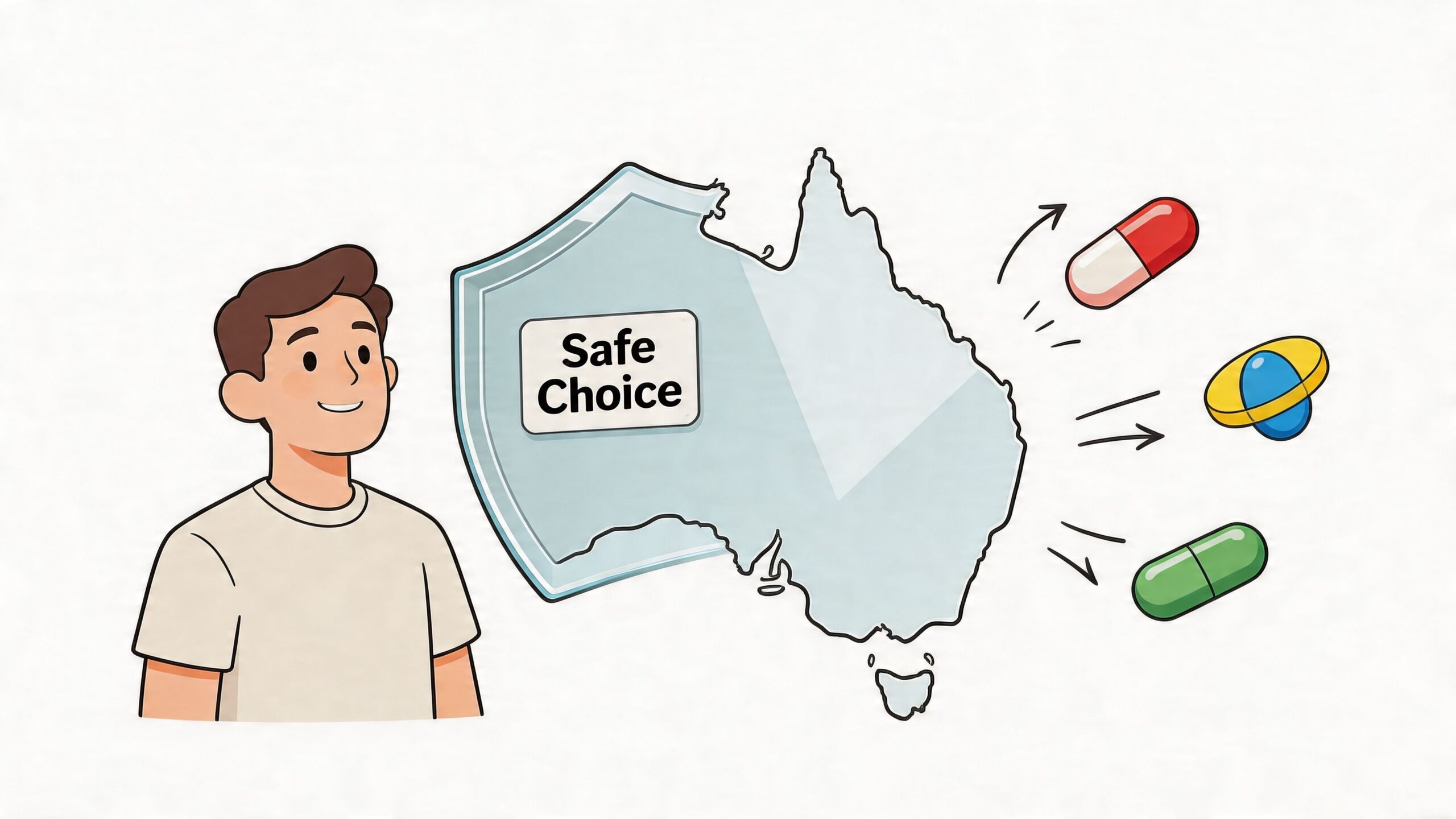
The bigger issue is interactions. The TGA reported a 28% increase in adverse events from combining ashwagandha with SSRIs, a class of medication used by over 1.8 million Australians, according to this summary of the risk. That’s not a fringe concern. It’s a reminder that self-prescribing can get messy quickly.
Common stress-related pairings that deserve caution include:
- Ashwagandha with antidepressant medication: This needs proper medical review rather than guesswork.
- Magnesium with blood pressure medication: Useful in some cases, inappropriate in others.
- Multi-ingredient formulas with unclear overlap: The more moving parts, the harder it is to identify what’s helping or causing side effects.
If sleep is part of the reason you’re considering stress support, it also helps to understand where your stress formula ends and your sleep formula begins. Wellthy’s guide to the best sleep supplements in Australia can help you avoid doubling up on ingredients with similar effects.
A simple pre-purchase checklist
Before you start anything, ask these questions:
- What medication am I taking regularly? Include prescriptions, not just occasional medicines.
- What is the actual goal? Calmer focus, less physiological stress, better sleep, or fewer afternoon crashes.
- Can I identify each active ingredient and dose? If not, skip it.
- Who have I told? Your GP and pharmacist should know what you’re taking.
The safest supplement is the one that matches your goal, your medical context, and your tolerance. Not the one with the best branding.
That approach isn’t fear-based. It’s efficient.
How to Choose a Quality Supplement in Australia
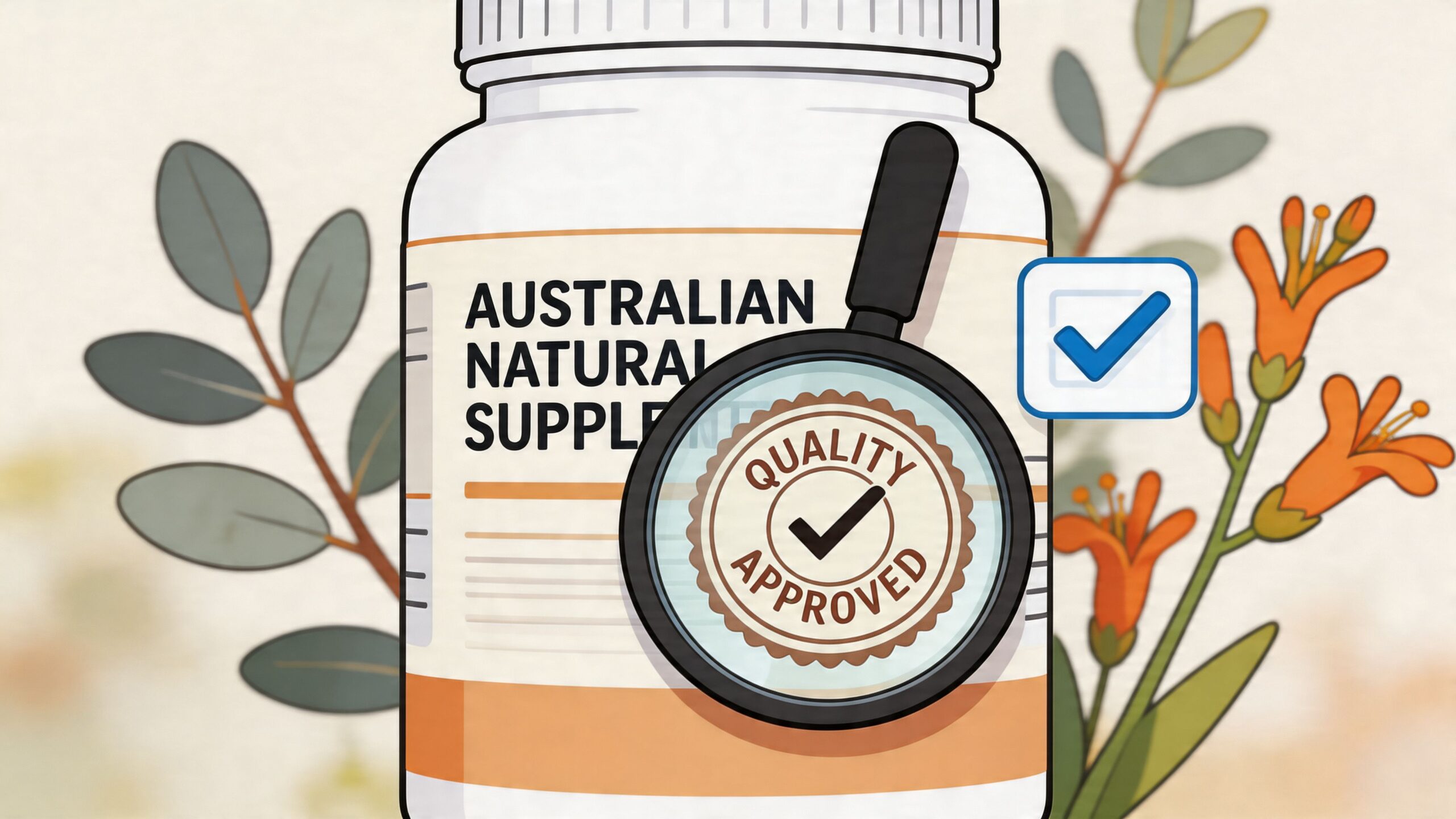
A strong ingredient can still be hidden inside a poor product; label literacy saves money.
Read the front less and the side panel more
The front of the bottle sells a feeling. The side panel tells you whether the product has any chance of doing the job.
When comparing options at Chemist Warehouse, a health food store, or through a practitioner, check these first:
- Active ingredient clarity: You want the specific ingredient named clearly, not a vague proprietary blend.
- Dose per serve: A product can contain the right herb or amino acid at a token amount.
- Single ingredient versus blend: Single-ingredient formulas are easier to trial and easier to troubleshoot.
- TGA context: An AUST L or AUST R number is worth noting as part of your due diligence.
Practitioner-only products often provide cleaner dosing logic and more targeted formulas. Over-the-counter products can still be useful, but they vary widely. Some are straightforward and well built. Others rely heavily on branding, buzzwords, and underdosed ingredient lists.
One example in the local market is Wellthy Revive, which is positioned as an adrenal and cortisol support supplement for stress and anxiety. That doesn’t make it automatically right for everyone, but it fits the category of products aimed at physiological stress support rather than simple sedation.
A quick visual explainer can help if labels still feel confusing at first glance.
Why personalisation matters
Even a technically good supplement may not work the same way for two different people. That’s one reason generic advice often disappoints.
A University of Melbourne pilot study found that 32% of participants with a common slow COMT gene variant showed no cortisol reduction from standard magnesium doses, according to this personalised supplementation discussion. The practical message isn’t that everyone needs a genetic panel tomorrow. It’s that biology isn’t one-size-fits-all.
That changes how I think about “failed” supplements. Sometimes the product is poor. Sometimes the dose is wrong. Sometimes the target was wrong. And sometimes the person’s underlying biology means a standard protocol won’t give a standard result.
A useful buying mindset for 2026 looks like this:
- Start with a clear goal.
- Choose one well-matched product.
- Review response carefully.
- Escalate to more personalised support if the basics don’t land.
That’s slower than impulse buying. It’s also more effective.
Supplements Are a Piece of a Larger Puzzle
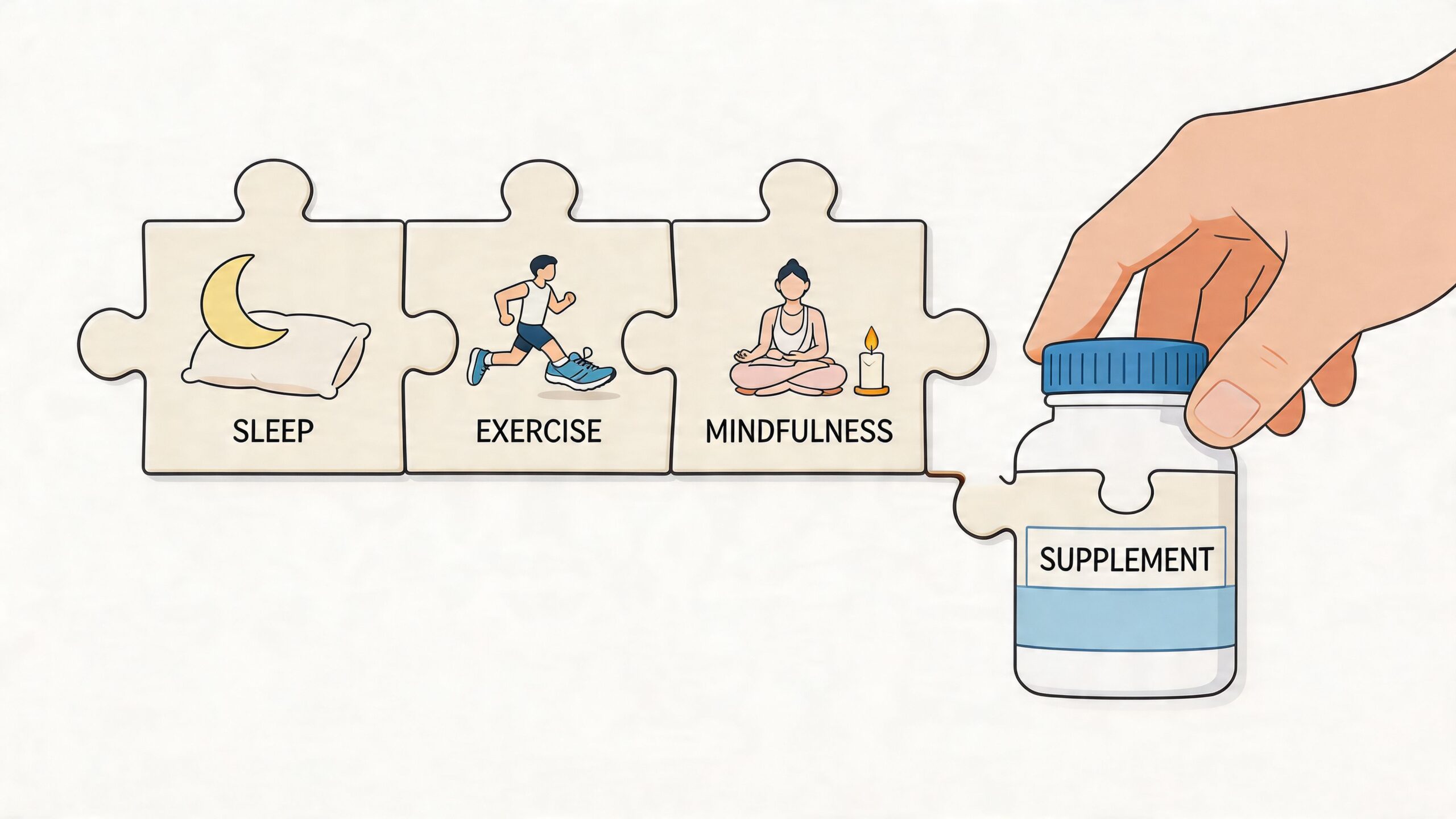
The best supplement for stress still can’t outrun a life built on overstimulation, poor sleep, skipped meals, and no downshift. That’s not a moral statement. It’s just physiology.
What makes supplements work better
Supplements tend to perform better when the body is getting a few consistent cues of safety and recovery.
A few examples matter more than people expect:
- Regular meals: Stable eating patterns can reduce the extra stress load that comes from blood sugar volatility and accidental undereating.
- Morning light and movement: A short walk early in the day helps anchor your rhythm and often improves stress tolerance later.
- Better sleep timing: Not perfect sleep. More consistent sleep.
- Time outside: Nature-based recovery works because it changes sensory load, pace, and mental state all at once.
A capsule can support regulation. It can’t replace recovery habits.
The idea of wellth becomes useful. The return comes from compounding. A sensible supplement plus a calmer morning plus less evening overstimulation plus more consistent food intake usually beats any single intervention on its own.
A realistic weekly rhythm
For a busy Australian professional, the routine doesn’t need to look dramatic.
One workable pattern might be:
- Weekday mornings: Light exposure, water, breakfast, then your chosen supplement if it suits morning use.
- During work: Build friction against constant activation. Fewer notifications, fewer context switches, more defined pauses.
- Evenings: Lower the stimulation load earlier than you think you need to.
- Weekends: Add something restorative that feels like a reset, not another performance task. A coastal walk, a yoga class, or a hike can do more for your stress chemistry than another “productivity” ritual.
For Queensland readers, even a simple outdoor session can be a meaningful reset. A half-day walk in a place like the Glass House Mountains doesn’t just tick the exercise box. It changes breathing, pace, visual load, and attention.
Supplements shine in this context. They support the system you’re building. They shouldn’t be expected to build it for you.
Building Your Sustainable Strategy for Calm
Stress management in 2026 needs more discernment than hype. The useful path is usually straightforward. Learn what your stress pattern looks like, choose a supplement for stress that matches that pattern, check safety properly, and use it inside a routine that supports recovery.
Ashwagandha makes sense for some people with high physiological stress load. L-theanine can be a strong option when calm focus matters. Magnesium can be valuable foundational support. None of them are universal, and none of them should be started carelessly if medication is involved.
The bigger win is thinking long term. Build a system that helps you feel steadier, sleep better, think more clearly, and recover more reliably. That’s a much better investment than chasing a quick fix every time life gets noisy.
If you want practical, Australia-specific wellness guidance that treats health as a long-term investment, explore Wellthy for evidence-informed articles on stress, sleep, nutrition, movement, and everyday routines that build real wellth over time.
Created with Outrank app


