
You’re awake again. It’s after 3 am, your mind is still running, and tomorrow isn’t getting any lighter. You’ve probably already tried the usual fixes. Less caffeine, a cooler room, maybe a herbal tea that promised more than it delivered.
That’s usually the point where people start searching for the best sleep supplements australia has to offer. The interest is understandable. In Australia, one in three people took a dietary supplement in 2023, and magnesium glycinate complementary medicines listed on the ARTG rose from 50 records in 2022 to 121 by September 2025, showing how quickly demand has grown for magnesium-based sleep support according to Statista’s Australia sleep aids market outlook.
A supplement can help. It can also waste money, create side effects, or give you false confidence if the underlying issue is stress, sleep apnoea, medication, alcohol, perimenopause, pain, or a badly timed routine. That’s why the useful question isn’t “What’s the strongest thing I can buy?” It’s “What’s legal, safe, and matched to my sleep problem in Australia?”
If you want a broader primer on best supplements for better sleep, that guide is a helpful companion. What matters here is the Australian lens. TGA compliance matters. Melatonin rules matter. Label literacy matters.
Table of Contents
- Tired of Counting Sheep An Introduction
- How Do Sleep Supplements Actually Work
- Understanding Australian Rules for Sleep Supplements
- How to Decide If a Supplement Is Right for You
- The Best Sleep Supplement Ingredients Explained
- Using Sleep Supplements Safely and Effectively
- Beyond the Bottle Building Sustainable Sleep
Tired of Counting Sheep An Introduction
Those who turn to supplements rarely do so out of a passion for them. They start because they’re tired, wired, and sick of functioning on half a tank. By the time someone walks into a pharmacy or fills an online cart, they usually want one thing. They want their brain to settle down at night without feeling foggy the next morning.
That’s where a practical approach matters. Sleep supplements can be useful for mild, stress-linked, or occasional sleep disruption. They’re far less impressive when they’re used to bulldoze through a bad routine, heavy alcohol intake, chronic pain, untreated anxiety, or snoring that suggests sleep apnoea.
Practical rule: Use supplements as support for a sleep routine, not as a substitute for one.
Australian buyers also face a problem that overseas guides often ignore. Many articles are written for markets where ingredients, claims, and product availability are completely different. Advice that sounds simple on a US site can be misleading here, especially regarding melatonin and imported products.
A smarter way to shop is to think like a clinician. Ask what your actual sleep issue is. Trouble winding down. Trouble falling asleep. Light sleep. Night waking. Stress-driven racing thoughts. Different patterns respond to different ingredients, and some don’t respond to supplements much at all.
That’s the filter I use in practice. Ignore the “knocks you out” marketing. Look for legal products, restrained claims, sensible formulations, and ingredients with a clear purpose.
How Do Sleep Supplements Actually Work
Sleep supplements don’t “switch off” the brain in the way people often imagine. Most of them work by nudging the nervous system toward a calmer state so sleep becomes more likely. That’s an important distinction. Good products support sleep readiness. They don’t force sleep in the way a sedative can.
Your brain needs a brake at night
A simple way to understand this is to think of your brain as having an accelerator and a brake. During the day, alertness, problem-solving, stimulation, screens, deadlines, and stress all keep the accelerator active. At night, your body needs enough braking signals for muscle tension to ease, mental chatter to quieten, and the transition into sleep to feel natural.
Some supplements support calming pathways linked with relaxation. Others help reduce the sense of being “tired but switched on”. A few are better for pre-bed tension than for staying asleep. That’s why product matching matters more than hype.
If travel has disrupted your rhythm, a supplement may only do part of the job. Re-setting timing cues, light exposure, meals, and behaviour often matters just as much. That’s the same reason practical strategies for avoiding jet lag when flying can sometimes improve sleep more than another capsule in the cupboard.
Supplements support processes, they don’t replace them
The body still needs the conditions for sleep. Darkness matters. A stable bedtime matters. A nervous system that isn’t constantly reactivated by email, alcohol, doomscrolling, or late-night work matters.
A supplement works best when the body already has permission to sleep.
People often get disappointed. They take a product while keeping every alerting habit in place, then conclude that “supplements don’t work”. Often the product wasn’t the main problem. The context was.
A more realistic expectation is this:
- Relaxation support: Some ingredients help you feel calmer before bed.
- Sleep onset support: Some are better when you take too long to fall asleep.
- Sleep quality support: Others may help sleep feel deeper or more restorative.
- Stress buffering: Some work best when stress is the thing pushing sleep off track.
That framework makes it much easier to judge what belongs in the conversation and what doesn’t.
Understanding Australian Rules for Sleep Supplements
Australia has stricter rules than many readers expect. That’s a good thing when it protects quality and labels, but it also creates confusion if you’ve been reading overseas content. The two terms worth knowing are TGA and ARTG.
Why the TGA matters
The Therapeutic Goods Administration regulates therapeutic goods in Australia. For everyday buyers, the practical takeaway is simple. Don’t just judge a product by branding, influencer praise, or how “natural” it sounds. Check whether it’s properly listed in the Australian system.
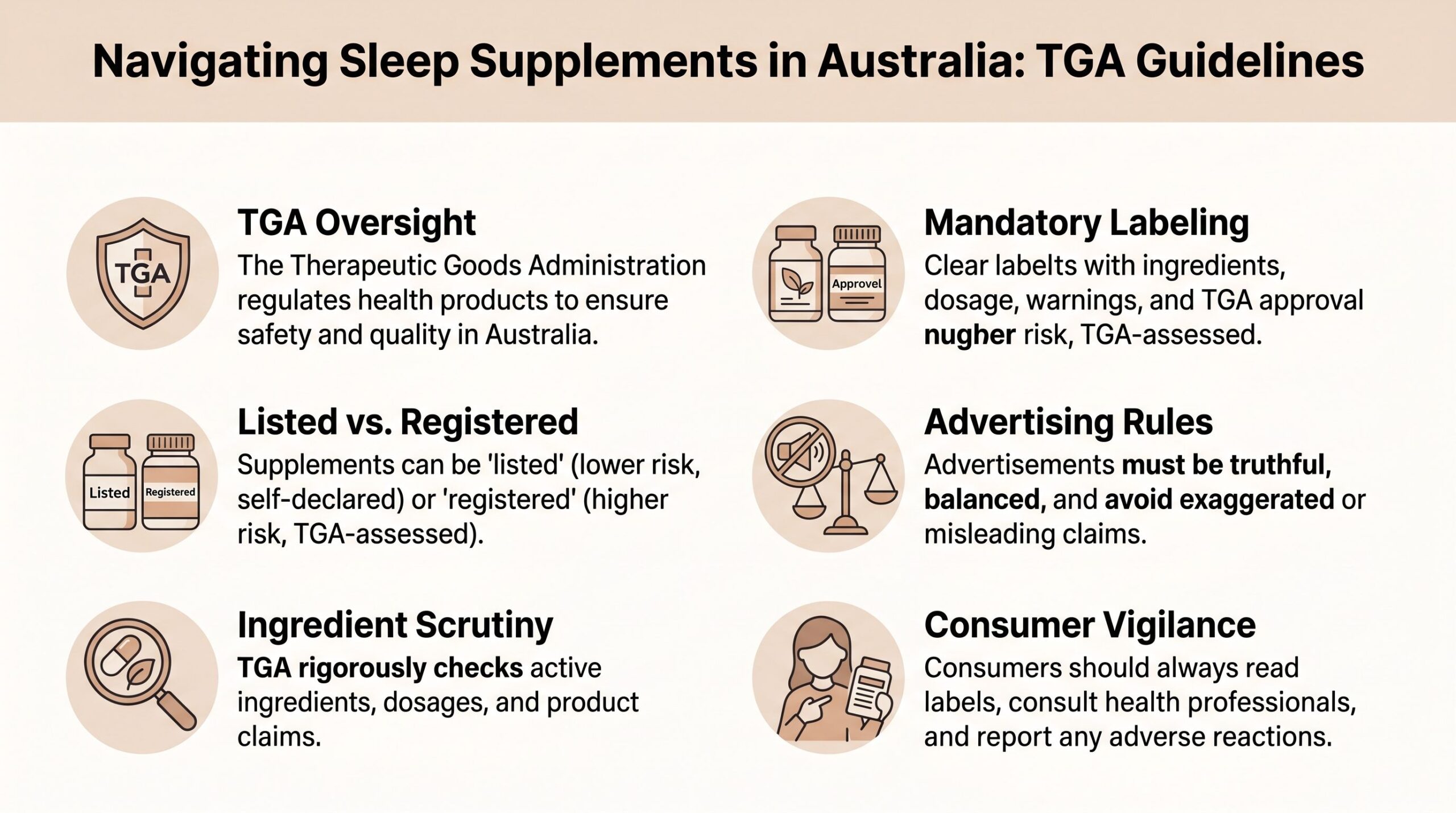
A compliant product should give you enough information to identify what it contains, how it should be used, and whether it belongs in the Australian regulatory framework. If a seller is vague about ingredients, dosage, warnings, or listing details, that’s not a small issue. It’s a reason to walk away.
The melatonin issue in Australia
Many shoppers face a difficulty: Melatonin is prescription-only in Australia, unlike in the US, and a 2025 consumer poll found that 40% of Australians using sleep aids were uncertain about their legality, as noted in this Australian report discussing the confusion around sleep aids and regulation.
That means many “sleep gummies” and imported products promoted online can create false expectations. If an overseas article says melatonin is the obvious first choice, that advice doesn’t automatically apply here. In Australia, over-the-counter sleep supplements generally rely on other ingredients such as magnesium, herbal extracts, or amino acids.
If a website markets an easy over-the-counter melatonin fix to Australian consumers, stop and verify before buying.
A quick label check before you buy
When I’m helping someone choose a sleep supplement, I want them to do three things before they care about branding.
- Check the ARTG listing: Look for the product in the Australian Register of Therapeutic Goods, not just on a retailer’s own website.
- Read the ingredient panel carefully: Know whether you’re buying a single ingredient or a multi-ingredient blend.
- Scan the warnings: Kidney issues, pregnancy, breastfeeding, and medication use all change the safety conversation.
A short store checklist helps:
| Check | Why it matters |
|---|---|
| AUST L or other listing details | Helps confirm the product sits within the Australian framework |
| Clear active ingredients | Shows what you’re actually taking |
| Dose instructions | Lets you compare products sensibly |
| Warning statements | Flags who shouldn’t use it without advice |
The safest buyer usually isn’t the one who buys the most expensive product. It’s the one who verifies it.
How to Decide If a Supplement Is Right for You
Not every sleep problem should be treated with a supplement. Some should be assessed. If you’ve had poor sleep for a long time, if you’re exhausted despite spending enough time in bed, or if your sleep is tied to breathing issues, pain, panic, reflux, or hormonal symptoms, you need a bigger plan than a tub of capsules.
When a supplement makes sense
A supplement can be reasonable when your sleep issue is occasional, pattern-based, and fairly easy to describe. For example, you know stress is making it hard to switch off. Or your sleep got messy after travel, work pressure, or a temporary routine blowout.
In those situations, the goal isn’t dependence. It’s support while you clean up the underlying drivers. That’s also where non-supplement tools matter. If your nervous system runs hot, techniques that reduce mental overactivation can make a supplement work better. The practical habits covered in this guide to mindfulness for anxiety are often more relevant than people think.
When you should speak to a doctor first
There are several situations where I’d want medical review before any self-prescribing:
- Persistent insomnia: If the problem is ongoing, it deserves proper assessment.
- Loud snoring or breathing pauses: These can point to sleep apnoea.
- Pregnancy or breastfeeding: Ingredient safety needs individual review.
- Medical conditions or regular medications: Interactions and contraindications matter.
- Daytime impairment: If you’re struggling to drive, focus, or function, don’t self-manage casually.
A decent self-check is to ask, “Am I trying to support sleep, or am I trying to override a problem I haven’t addressed?” If it’s the second one, supplements often become expensive clutter.
Buy a supplement when the problem is clear enough to match. Pause when the problem is bigger than the label.
The Best Sleep Supplement Ingredients Explained
If you’re comparing the best sleep supplements australia offers, focus on ingredients first. Brand names change. Packaging changes. Ingredient logic is what holds up.
Magnesium glycinate
This is one of the most practical starting points for adults who feel tense, wired, or physically tight at night. In adults with poor sleep, magnesium supplementation improved deep-sleep duration within two weeks, according to the clinical summary in this review of natural sleep supplements available in Australia.
Magnesium glycinate is often chosen because it’s generally well tolerated and tends to suit people who don’t do well with harsher forms. It makes more sense when your sleep issue includes muscle tension, stress load, or that familiar “my body is in bed but my system isn’t done yet” feeling.
What it may not do well is act like a strong sedative. If you expect to feel knocked out, you’ll probably judge it unfairly.
L-theanine
L-theanine is better thought of as a calming aid than a sleeping pill. The same Australian market review notes that 200 mg doses enhanced sleep restfulness. That makes it useful for people who don’t necessarily need heavy sedation but do need less mental friction at bedtime.
I tend to like it for busy professionals, overthinkers, and people who say they’re tired but mentally alert. It can also fit well in combination formulas, though I usually prefer trialling ingredients one at a time first so you can tell what’s doing what.
Its limitation is straightforward. If your main issue is repeated waking due to pain, reflux, or breathing disruption, L-theanine may not be solving the core issue.
Chamomile valerian and hops
These herbs often show up in traditional-style sleep blends. They can be useful, especially for people who prefer a gentler herbal option and like the ritual side of evening care. Some people respond well to blends that combine nervous system calming with a mild “settling” effect.
Valerian is the stronger personality in this group. It has a reputation for helping with sleep quality, though not everyone likes how herbal formulas feel or smell, and some people don’t notice much. Chamomile is often milder and better suited to people who want a softer nudge. Hops commonly appears as part of a blend rather than a stand-alone star.
Comparing Common Sleep Supplement Ingredients
| Ingredient | How it Works | Best For | Things to Consider |
|---|---|---|---|
| Magnesium glycinate | Supports relaxation pathways and can suit a tense, wired body | Stress-linked sleep issues, physical tension, light poor-quality sleep | Usually better as a steady trial than a one-night test |
| L-theanine | Promotes a calmer mental state and may support sleep restfulness | Racing thoughts, work stress, bedtime overthinking | Better for mental settling than heavy sedation |
| Chamomile | Gentle herbal calming support | Mild bedtime tension, people wanting a softer option | May feel too mild for significant sleep disruption |
| Valerian | Herbal sleep support often used for sleep quality | People who respond well to traditional herbal formulas | Not everyone likes the feel or notices a strong effect |
| Hops | Commonly paired with other herbs for calming support | Blend formulas aimed at bedtime settling | Often works as part of a formula rather than alone |
A practical buying rule is to match the ingredient to the pattern:
- Wired and tense: Magnesium glycinate is often the more sensible first look.
- Mentally switched on: L-theanine may be a better fit.
- Want a herbal blend: Chamomile, valerian, and hops are common options.
- No clear pattern: Don’t buy the biggest blend. Clarify the problem first.
Using Sleep Supplements Safely and Effectively
The safest way to trial a sleep supplement is boring. That’s usually a good sign. You want a method that lets you judge effect, spot side effects early, and avoid turning a simple experiment into a chemistry set.
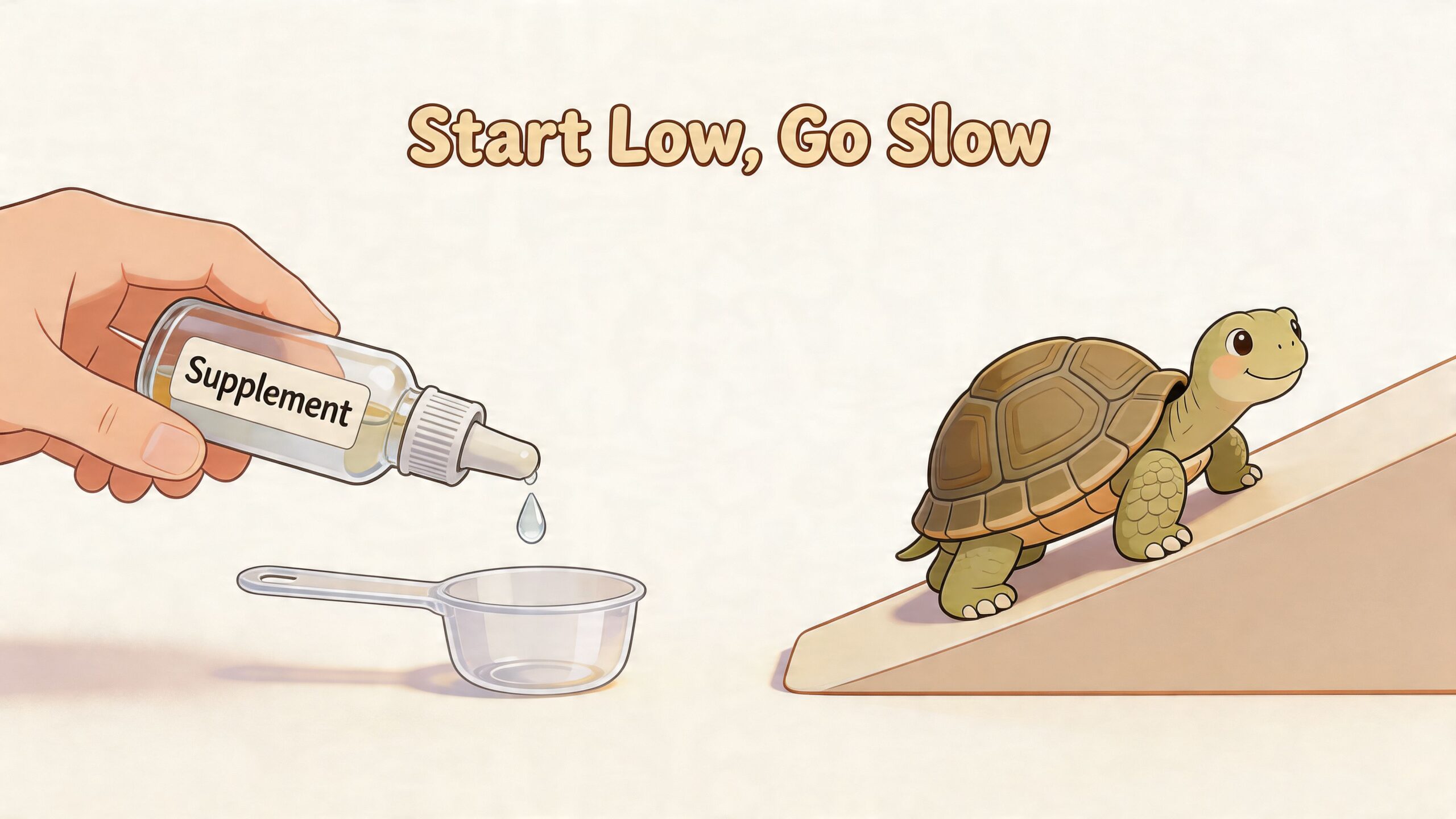
Start with one ingredient not a kitchen sink blend
A lot of products look impressive because the label is crowded. That doesn’t always make them better. It often makes them harder to assess. If you wake groggy, get a headache, or feel no benefit, you won’t know which ingredient deserves credit or blame.
Start with one ingredient when possible. Give it a fair trial. Keep the rest of your evening routine steady so you can tell whether it helps.
Clinical habit: Trial one product at a time and keep a simple sleep note with bedtime, sleep onset, night waking, and next-day grogginess.
This is also where it helps to understand the potential downsides of supplement use before layering products together. “Natural” doesn’t automatically mean harmless, especially when you’re mixing multiple formulas with other medications.
Timing dose and interaction basics
For magnesium glycinate, 350 mg before bed is often recommended, and its bioavailability is described as over 80% absorption, which is one reason it’s commonly preferred. The same guidance notes that some other forms can cause GI upset at doses over 400 mg, based on this practitioner-style overview of sleep supplements and magnesium glycinate.
That doesn’t mean everyone should start at the top end. I still prefer a conservative approach. If a formula suggests evening use, take it as directed and keep timing consistent for several nights before judging it.
Here’s the practical version:
- Start low if the product allows it: Especially if you’re sensitive to supplements.
- Take it at the same time each night: Random timing gives messy results.
- Avoid combining several new products at once: You lose clarity fast.
- Review your medications with a pharmacist or GP: This matters with antidepressants, blood pressure medication, sedating medicines, and anything with interaction potential.
A short explainer can help if you prefer visual guidance:
Stop and get advice if these show up
Most problems people have with sleep supplements are predictable. They feel too groggy. They get digestive upset. They stack products unnecessarily. Or they keep taking something that isn’t helping because the marketing was persuasive.
Stop the trial and get advice if you notice:
- Next-day sedation: Especially if you need to drive or work safely.
- Palpitations, unusual symptoms, or feeling worse: Don’t push through that.
- GI upset that persists: Re-check the form, dose, and product.
- No benefit after a fair trial: Move on rather than escalating blindly.
Good supplement use should feel measured, not desperate.
Beyond the Bottle Building Sustainable Sleep
The best sleep supplement is the one that fits the problem, sits within Australian rules, and doesn’t distract you from the basics that keep sleep stable. For many people, that means starting with a legal, clearly labelled product and a single ingredient rather than chasing imported shortcuts or oversized blends.
Supplements can support the process. They usually can’t carry it alone. If your sleep improves only when everything else is still chaotic, the result rarely lasts. Stable sleep is built from repeatable inputs. A dark room, regular timing, less late-night stimulation, and a nervous system that gets some help unwinding before bed.
For a lot of busy Australians, screen exposure is one of the most under-rated sleep disruptors. If your nights are fuelled by constant input, the habits in this guide to a digital detox for mental wellth can do more than another trendy blend.
Use supplements as part of a broader routine. Verify TGA compliance. Read labels properly. Match ingredients to your symptoms. And if the story feels more medical than lifestyle-based, get assessed instead of self-experimenting for months.
If you want more practical, Australia-specific wellness guides that treat health like a long-term investment rather than a quick fix, explore Wellthy. It’s a strong resource for building sustainable routines around sleep, stress, recovery, food, movement, and everyday vitality.