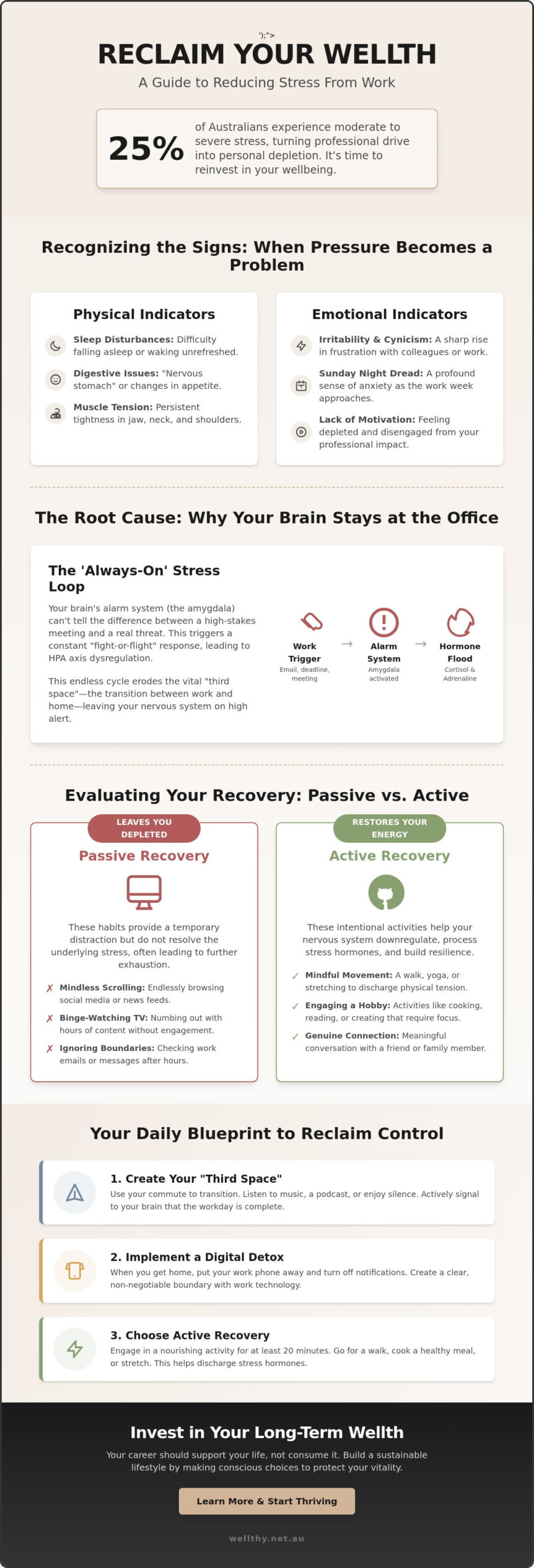
What if the persistent tension in your shoulders and the 9:00 PM urge to check your inbox aren’t signs of dedication, but signals that your most valuable asset is being mismanaged? You’re likely familiar with that “wired but tired” feeling, where the mental chatter of the office follows you into your living room. You aren’t alone in this struggle. The 2023 Australian Psychological Society Stress and Wellbeing report indicates that 25% of Australians experience moderate to severe levels of stress. Understanding how to reduce stress from work is no longer a luxury; it’s a vital investment in your personal wellth.
We agree that your professional drive shouldn’t come at the cost of your physical and mental harmony. This guide offers a holistic framework to manage workplace pressure, set sustainable boundaries, and reclaim your vitality. You’ll learn how to replace guilt with clarity and restore the energy levels needed for a vibrant personal life. We’ll walk through evidence-based steps to create a clear divide between the office and home, ensuring your career supports your life rather than consuming it.
Key Takeaways
- Learn to recognize stress as a vital signal for reinvestment, helping you bridge the gap between professional demands and your personal resources.
- Understand the biological triggers that keep your brain “at the office” and how to transition effectively into a state of genuine rest.
- Master how to reduce stress from work by choosing active, nourishing recovery over passive habits that leave you feeling depleted.
- Create a personalized blueprint for long-term vitality by integrating sustainable sleep and nutrition into your professional lifestyle.
- Discover a step-by-step daily guide to reclaiming control, ensuring your career becomes a source of ‘wellth’ rather than a drain on your health.
Recognizing the Signs: When Professional Pressure Becomes Personal Stress
Work-related stress occurs when the demands of your professional role exceed your personal resources and capacity to cope. It’s a common experience for many Australians. Data from Safe Work Australia indicates that mental health conditions now account for approximately 9 percent of all serious workers’ compensation claims. We view Occupational stress not as a personal failure, but as a vital signal from your body. It’s an invitation to pause and reinvest in your “Wellth,” the holistic currency of your health, vitality, and happiness.
Understanding the difference between types of pressure is essential for long-term health. Healthy “eustress” provides the spark of motivation you need to hit a deadline or excel in a presentation. It feels like a surge of energy. Chronic “distress” is the opposite. It’s a heavy, sustained weight that leads to exhaustion. Learning how to reduce stress from work begins with identifying when that positive momentum has shifted into a state of depletion.
Physical and Emotional Indicators of Burnout
Your body often signals distress long before your mind acknowledges the problem. These somatic signs are clear indicators that your internal reserves are low. Watch for these common symptoms:
- Sleep disturbances, including difficulty falling asleep or waking up feeling unrefreshed.
- Digestive issues, such as a “nervous stomach” or changes in appetite.
- Persistent muscle tension, particularly in the jaw, neck, and shoulders.
Emotional red flags are equally telling. You might notice a sharp rise in irritability with colleagues or a growing sense of cynicism regarding your professional impact. Many people experience a profound sense of “dread” on Sunday nights as the work week approaches. Burnout is the total depletion of one’s emotional and physical wellth reserves.
The Hidden Cost of ‘Always-On’ Culture
The rise of constant connectivity through Slack, email, and instant notifications has fundamentally altered the Australian workplace. This expectation of perpetual availability erodes your cognitive recovery. When your brain is constantly scanning for the next pinger or update, it never enters the restorative state required for deep focus and creativity. It’s an unsustainable way to live and work.
This culture has also caused the erosion of the “third space,” which is the vital transition period between your professional duties and your home life. Without a clear boundary, the pressures of the office bleed into your sanctuary. Protecting this transition is a key step in discovering how to reduce stress from work while maintaining your personal vitality. By reclaiming this space, you allow your nervous system to downregulate, ensuring you return to work with a sense of balance rather than resentment.
Understanding the Stress Response: Why Your Brain Stays at the Office
Your brain is an expert at survival. It’s designed to keep you safe from immediate physical threats, but it hasn’t quite caught up to the modern corporate world. The difficulty arises because your amygdala, the brain’s alarm system, cannot distinguish between a literal predator and a high-stakes board meeting. When you face a tight deadline or a difficult conversation, your body reacts as if your life is at risk. This biological glitch explains why you might find yourself ruminating on emails long after you’ve closed your laptop. Understanding this mechanism is the first step in learning how to reduce stress from work effectively.
Cortisol, Adrenaline, and the Fight-or-Flight Response
In a high-pressure Australian corporate environment, your adrenal glands often pump out cortisol and adrenaline on a loop. While popular culture frequently references “adrenal fatigue,” the scientific reality is usually HPA axis dysregulation. This happens when the communication between your brain and your adrenal glands becomes frayed from constant overuse. Elevated cortisol levels act like a slow-release toxin, inhibiting your body’s ability to enter a state of deep, restorative rest. This prevents you from building “wellth,” our term for the holistic vitality that allows you to thrive rather than just survive. Without a break in this cycle, your system stays prepared for a battle that never arrives.
Acute Stress vs. Chronic Workplace Strain
It’s helpful to differentiate between a temporary rush and a long-term burden. Acute stress is the short-term spike you feel during a 48-hour project push. Chronic strain is the relentless, daily pressure of a toxic culture or an unmanageable workload. Scientists call the resulting wear and tear “allostatic load.” A high allostatic load can lead to significant health issues; research indicates that prolonged workplace pressure increases cardiovascular risks by 20 percent. The CDC emphasizes that preventing job stress is essential for long-term health. You can identify your current state by looking at your recovery time; if a weekend isn’t enough to make you feel human again, you’re likely dealing with chronic strain.
Throughout the average 9-to-5 day, you encounter dozens of ‘micro-stressors.’ These range from a passive-aggressive Slack message to a sudden change in a project’s scope. Individually, they seem small. Collectively, they keep your stress response cycle open. To protect your well-being, you must intentionally close this cycle before you go to bed. Physical movement, a warm bath, or even five minutes of focused breathing can signal to your nervous system that the danger has passed. If you’re feeling overwhelmed by these daily pressures, you might find it helpful to invest in personalized support to help realign your health goals and reclaim your vitality. Learning how to reduce stress from work starts with acknowledging that your body needs a clear signal to stand down.
Evaluating Stress Relief: Passive vs. Active Recovery
To truly understand how to reduce stress from work, we must distinguish between activities that numb us and those that nourish us. Passive recovery, such as watching television or having an extra glass of wine, often feels like the path of least resistance after a demanding day. For those looking to shift toward more nourishing rituals, exploring options at drinklodo.com can provide a mindful way to decompress without the negative impact of traditional spirits. While these habits provide a temporary distraction, they rarely close the physiological stress cycle. Your nervous system remains in a state of low-grade alertness; this keeps cortisol levels elevated even while you’re physically still. Incorporating expert advice on managing work stress can help you identify if your current habits are actually helping you recover or just masking the exhaustion.
Shifting your focus toward active recovery is a high-yield investment in your personal vitality. It’s about moving from a state of depletion to one of genuine wellth by choosing actions that signal safety to your brain. According to 2023 data from the Australian Bureau of Statistics, over 15% of Australians experience high or very high levels of psychological distress, highlighting the urgent need for effective recovery strategies. This approach requires more initial effort than sitting on the couch, but the return on your energy is significantly higher. You aren’t just passing time; you’re actively restoring your capacity to thrive.
Why ‘Doomscrolling’ Isn’t Real Rest
The habit of ‘doomscrolling’ through social media or news feeds creates a punishing dopamine-cortisol loop. Your brain seeks a quick reward from the scroll, but the content often triggers a subtle stress response. This constant information overload, combined with blue light exposure, prevents your brain from entering a parasympathetic state. We suggest a ‘digital sundown’ ritual to protect your mental wellth. Turn off your screens at least 60 minutes before bed. This simple boundary allows your mind to decompress and ensures your sleep is restorative rather than just a period of unconsciousness.
The Power of Active Recovery and Movement
Active recovery isn’t about hitting a new personal best at the gym. It’s about functional movement that tells your body the ‘threat’ of the workday is over. Short bursts of activity are often more effective than an hour of forced exercise. Consider these low-impact options:
- A 15 minute walk around your local park to reconnect with your surroundings.
- Gentle yoga or stretching during your final calls of the day.
- Breathwork exercises that focus on long, slow exhales.
Find joy in the rhythm of your body. When you view movement as a gift of nourishment rather than another fitness goal, it becomes a sustainable part of your holistic health. By choosing active recovery, you’re learning how to reduce stress from work in a way that actually repairs the body rather than just silencing the symptoms. This shift in perspective turns a chore into a restorative practice that builds long-term resilience and alignment.
A Step-by-Step Guide to Reducing Work Stress Daily
You don’t need a month-long retreat to reclaim your peace. Investing in your wellth starts with the small, repeatable actions that define your day. True vitality comes from these micro-adjustments, particularly during transition periods like your morning coffee or the digital commute from your home office. Learning how to reduce stress from work isn’t about massive life overhauls; it’s about reclaiming the minutes you already have.
Mastering Boundary Setting and Communication
Clear communication is the foundation of a sustainable career. When a non-urgent request lands on your desk, try a straightforward script: “I’m dedicating my focus to the quarterly budget right now to ensure it’s accurate. I can review your request tomorrow morning at 10 am.” This protects your cognitive energy and sets a professional standard. Single-tasking reduces the friction of context switching. Research from the University of California suggests it takes an average of 23 minutes to return to a task after an interruption. Setting “out of office” expectations should be firm. State clearly when you’ll be back and who to contact for emergencies, then actually disconnect to allow your mind to recover.
Implementing Micro-Mindfulness and Desk Rituals
You can shift your nervous system from “fight or flight” to “rest and digest” in under two minutes. Use the Box Breathing technique: inhale for four seconds, hold for four, exhale for four, and hold for four. This provides immediate physiological calm. If a call feels overwhelming, use sensory grounding. Identify three things you can touch, like the texture of your desk or the cool surface of a water bottle. Your physical environment also dictates your internal state. Align your workspace with your health goals by adding a hardy indoor plant or ensuring your monitor is at eye level to prevent physical strain. These small investments in your surroundings pay dividends in daily focus.
The ‘Shutdown Ritual’: Closing the Professional Loop
Open loops are a primary cause of evening anxiety. Spend the last 10 minutes of your day clearing your mental cache. Write down your top three priorities for tomorrow. This simple act signals to your brain that the work identity is pausing. Create a physical anchor to finish the day. Close your laptop, put your mouse in a drawer, or change into different clothes immediately. These actions help you understand how to reduce stress from work by creating a hard border between your professional output and your personal life. It’s about ending the day with a sense of completion rather than a lingering list of “what ifs.”
Ready to build a more resilient lifestyle and improve your daily performance? Invest in your long-term wellth today.
Investing in Long-Term Wellth: Building a Sustainable Lifestyle
Managing daily pressure is a necessary skill, but true well-being requires a fundamental shift in perspective. Instead of just learning how to reduce stress from work as a temporary survival tactic, we invite you to focus on thriving through long-term alignment. Your health is your greatest asset. It is the “wellth” that funds every other part of your life, from your career trajectory to your family connections. Building resilience starts with the basics: personalized nutrition that fuels your unique biology and rigorous sleep hygiene that restores your nervous system after a demanding day at the office.
You aren’t a collection of professional data points or a series of KPIs. You’re a human being who deserves vitality. Wellthy acts as your dedicated partner in this journey, providing the care coordination needed to navigate the often confusing world of holistic health. We believe that nourishment goes beyond what’s on your plate; it encompasses your environment, your movement, and your mental clarity. By focusing on these pillars, you move from a state of constant reaction to one of proactive strength.
Creating a Supportive Work-Life Integration Plan
The concept of work-life balance is often a myth that creates more pressure than it relieves. It suggests a perfect 50/50 split that rarely exists in a modern Australian career. Integration is the reality. It is about how your professional responsibilities and personal joy occupy the same space harmoniously. Start by conducting a regular audit of your personal values against your calendar. If 80% of your time is spent on tasks that don’t align with your core values, stress is an inevitable byproduct.
We help bridge this gap through strategic Health and Fitness Brand Partnerships, ensuring you have access to the tools and communities that make this integration feel seamless. When the brands you use and the habits you form align with your goals, sustainable growth becomes your standard. This approach ensures that your lifestyle supports your work, rather than your work consuming your life.
When to Seek Professional Support
There are times when self-management reaches its limit. According to data from the Black Dog Institute, roughly one in five Australians take time off each year due to feeling mentally unwell. Knowing how to reduce stress from work includes recognizing when you need an expert’s hand. If you experience persistent insomnia, a loss of interest in hobbies, or physical symptoms like chronic tension headaches for more than two weeks, it’s time for professional care coordination or counseling. To find tailored assistance for your mental health, check out WJW Counselling & Mediation.
Many Australian workplaces offer Employee Assistance Programs (EAPs) that provide short-term support. However, private wellness coaching offers a more bespoke, long-term strategy for those looking to rebuild their lifestyle from the ground up. Whether it is through a GP-led mental health plan or a private consultant, reaching out is a sign of high-level management, not a lack of control. Investing in your health is the only investment that never loses its value.
Take Charge of Your Professional Well-being
Reclaiming your vitality isn’t a luxury; it’s a necessary investment in your long-term health. By moving from passive distractions to active recovery strategies, you create a sustainable rhythm that protects your personal life from professional pressure. Learning how to reduce stress from work requires more than a simple weekend off. It involves reshaping daily habits and aligning your lifestyle with evidence-based holistic health insights that respect your unique circumstances. This shift transforms the way you navigate the Australian professional landscape, turning burnout into a manageable challenge rather than an inevitability.
Expertly curated by Angie Neal, Wellthy provides a sophisticated perspective on modern wellness that prioritizes the human element. We believe health is a form of currency, a type of “wellth” that grows through intentional care and professional guidance. Our approach moves beyond temporary fixes to offer a reliable anchor in a complex world. You have the power to cultivate a life defined by harmony and steady momentum. It’s time to treat your vitality as your most valuable asset.
Invest in your personal ‘wellth’ by exploring our latest wellness features and brand guides.
Your journey to a more balanced and vibrant life begins with a single, mindful choice.
Frequently Asked Questions
What are the first signs that work stress is becoming dangerous?
The first signs of dangerous work stress include persistent physical symptoms like tension headaches, digestive issues, or chronic fatigue that doesn’t resolve with rest. According to Safe Work Australia, mental health conditions now account for 9% of all serious workers’ compensation claims. If you notice a decline in cognitive function or a sense of emotional detachment, your body is signalling that your current load is unsustainable. Investing in your wellth means listening to these early warnings before they manifest as long-term illness.
Can I reduce work stress without actually working fewer hours?
You can effectively learn how to reduce stress from work without cutting your hours by optimising your cognitive energy and setting firm micro-boundaries. Research from the University of Melbourne suggests that taking short, active breaks every 90 minutes can prevent the accumulation of cortisol. Focus on high-impact tasks during your peak energy periods and use tools like the Pomodoro technique to maintain a sustainable rhythm. This approach helps you build professional vitality while maintaining your current commitments.
How do I talk to my manager about being overwhelmed without looking weak?
Frame the conversation around productivity and resource allocation rather than personal capacity. Approach your manager with a list of current projects and ask for guidance on which tasks take priority to ensure the highest quality of work. This demonstrates professional maturity and a commitment to the company’s goals. By presenting a solution-oriented plan, you’re not showing weakness; you’re managing your professional assets to ensure long-term contribution.
Is it possible to ‘disconnect’ if my job requires me to be on-call?
Disconnecting while on-call is possible by establishing clear triage protocols that define what constitutes a true emergency. Create a physical ritual to signal the transition into your personal time, such as changing clothes or taking a five-minute walk. The Fair Work Commission’s 2024 “right to disconnect” laws provide a framework for Australian employees to manage out-of-hours contact. This legal clarity helps you protect your mental space while remaining available for critical operational needs.
What are the best foods to eat to help my body handle workplace stress?
Focus on magnesium-rich foods like spinach, pumpkin seeds, and almonds to help regulate your nervous system. Complex carbohydrates such as oats or brown rice provide a steady release of glucose, preventing the energy crashes that heighten irritability. A 2022 study in the British Journal of Nutrition found that high-fibre diets are linked to lower levels of perceived stress. Nourishing your body with whole foods is a practical way to build your internal wellth and resilience.
How long does it take to recover from professional burnout?
Full recovery from professional burnout typically takes between 12 and 18 months, depending on the severity of the exhaustion. It’s a gradual process of nervous system regulation and lifestyle realignment. The Black Dog Institute emphasises that recovery isn’t just about resting; it requires addressing the underlying causes of the stress. Patience is essential as you rebuild your vitality and integrate more sustainable habits into your daily routine.
Can simple breathing exercises really make a difference in a high-pressure meeting?
Simple breathing techniques like the “box breathing” method used by tactical athletes can significantly lower your heart rate during a high-pressure meeting. By slowing your breath, you signal to your brain that you’re safe, which dampens the “fight or flight” response. This allows you to maintain access to your prefrontal cortex for clearer decision-making. It’s a discreet, evidence-based tool that helps you stay grounded and composed when the stakes are high.
What should I do if my workplace culture is the primary source of my stress?
If the culture is the root cause, start by documenting specific instances of toxicity while exploring internal support systems like Employee Assistance Programs. Understanding how to reduce stress from work in a toxic environment often involves setting rigid emotional boundaries and focusing on your life outside the office. If the environment doesn’t align with your values, it might be time to plan a strategic transition. Your health is your most valuable currency, and no role is worth compromising your long-term well-being.