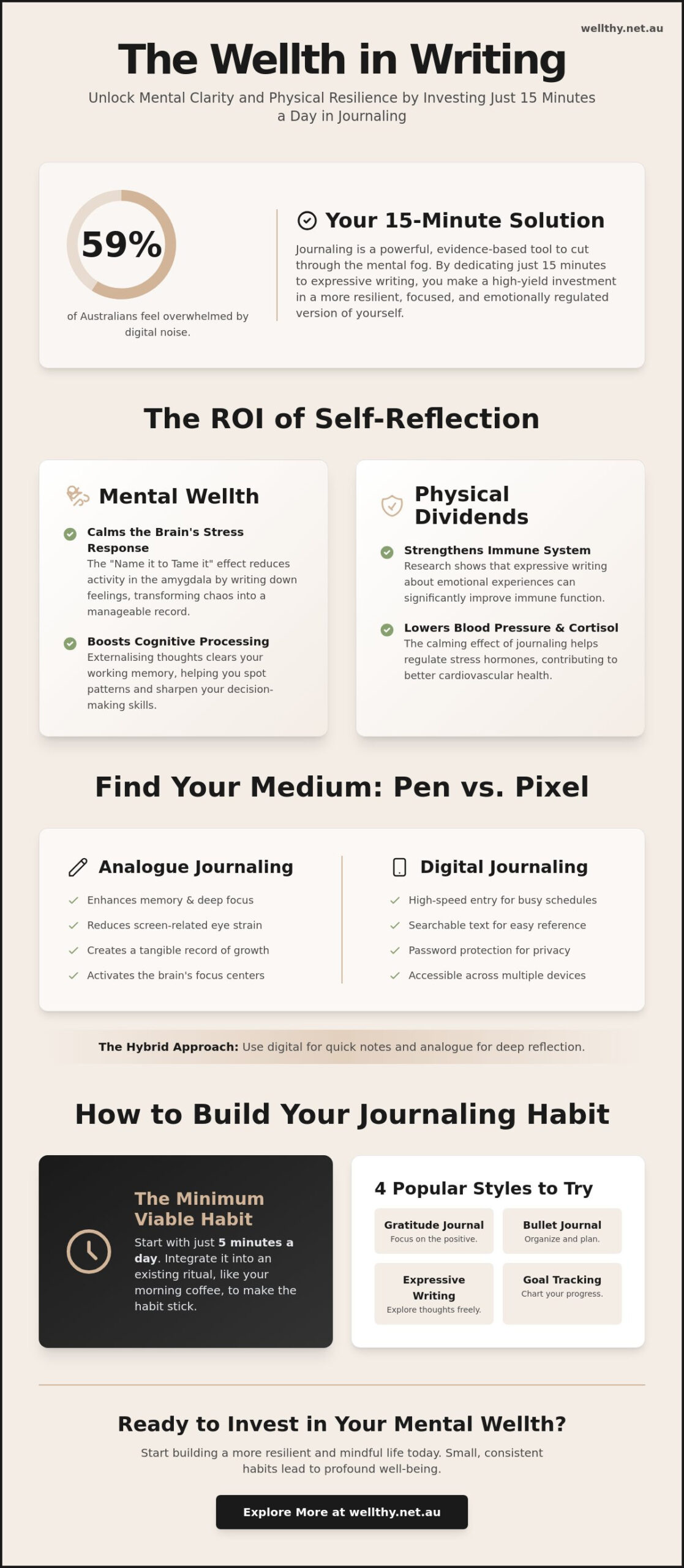
What if the most effective way to grow your wellth didn’t involve a financial advisor, but rather a simple pen and paper? In a world where roughly 59% of Australians report feeling overwhelmed by the constant stream of digital noise, finding a way to clear the mental fog is essential for your long-term vitality. The scientific benefits of journaling go far beyond mere record-keeping. They act as a powerful, evidence-based tool for emotional regulation and physical recovery. By dedicating just 15 minutes to this practice, you’re not just writing; you’re making a high-yield investment in a more resilient and focused version of yourself.
It’s natural to feel that your self-care routine is often the first thing to suffer when life gets busy. We know how difficult it is to process complex emotions when you’re caught in the rush of daily demands. This article will show you exactly how the simple act of writing can sharpen your decision-making and significantly lower your stress levels. We’ll explore the biological impact of expressive writing and provide a practical guide to help you integrate this restorative habit into your lifestyle today.
Key Takeaways
- Move beyond the “Dear Diary” trope and discover how intentional writing serves as a proactive tool for cognitive processing and emotional self-regulation.
- Understand the benefits of journaling for your mental ROI, specifically how “naming” your thoughts can physically calm the brain’s stress response.
- Explore the surprising physical dividends of expressive writing, including research-backed links to a stronger immune system and lower blood pressure.
- Learn how to tailor your practice using diverse styles like gratitude or bullet journaling to better align your daily productivity with mindful living.
- Start building your mental wellth with the “Minimum Viable Habit” approach, seamlessly integrating five minutes of reflection into your existing daily rituals.
Beyond the Diary: What is Modern Journaling?
Modern journaling is far more than a passive record of daily events. It functions as a proactive tool for self-regulation and cognitive processing, allowing you to externalise the mental clutter that often leads to burnout. By moving past the “Dear Diary” trope, you transition into expressive, intentional writing that serves as a private laboratory for your thoughts. This practice creates a bridge between your internal experience and your external actions, helping you navigate the complexities of life with greater poise. One of the primary benefits of journaling is its ability to transform abstract anxieties into concrete challenges that you can solve.
In our digital-first world, the act of writing serves as a necessary analogue detox. It provides a rare moment of stillness where the only notification is the movement of your own thoughts. When you commit pen to paper, you engage in a neurological process that typing simply cannot replicate. This tactile connection activates the brain’s reticular activating system, filtering out distractions and anchoring your focus on what truly matters for your long-term vitality. For those who find the pull of screens particularly difficult to resist, exploring practical digital detox tips can help you create the intentional offline space that makes journaling truly effective.
The Evolution of Expressive Writing
The history of journaling is populated by leaders and thinkers, from Marcus Aurelius to Leonardo da Vinci, who used the page to sharpen their intellect. Over time, the practice has shifted from merely recording external events to exploring internal narratives. This transition was formalised in the late 20th century through research into Journal therapy, which demonstrated that writing about emotional experiences can significantly improve physical and mental health outcomes. Modern science, including studies led by Dr James Pennebaker since 1986, confirms that intentional writing strengthens the immune system and reduces physiological stress. Journaling is a compounding investment in your personal wellth, yielding dividends of clarity and emotional resilience over a lifetime.
Digital vs. Analogue: Finding Your Flow
Choosing your medium is a personal decision that impacts your neurological engagement. Tactile writing is superior for memory retention and deep focus because the slower pace of handwriting allows your brain to process information more thoroughly. For many Australian professionals, the physical notebook becomes a sacred space, a sanctuary away from the blue light of screens and the demands of the workplace.
- Analogue benefits: Enhanced sensory engagement, reduced eye strain, and a permanent, physical archive of your growth.
- Digital benefits: High-speed entry for busy schedules, searchable text, and password protection for sensitive reflections.
- The Hybrid Approach: Using apps for quick gratitudes during a commute while saving deep, expressive sessions for a physical notebook.
To maximise the benefits of journaling, focus on creating a ritual that feels sustainable. Whether you use a high-end fountain pen or a simple smartphone app, the goal is to create a consistent channel for self-expression. By establishing this dedicated space, you ensure that your mental well-being is never left to chance.
The Mental Health ROI: Benefits of Journaling for Clarity
Think of your mind as a high-performance engine that occasionally gets bogged down by too much data. When you experience circular thoughts, you’re essentially idling in high gear without moving forward. One of the primary benefits of journaling is its ability to externalise this mental load. By moving thoughts from your head onto paper, you clear the cache of your working memory. This isn’t just a metaphor; it’s a physiological shift. Neuroscientists have observed the “Name it to Tame it” effect, where the act of writing down feelings reduces activity in the amygdala, the brain’s emotional alarm system. This process transforms a chaotic internal narrative into a manageable external record.
Investing time in Journaling for Emotional Wellness allows you to build emotional intelligence through consistent self-reflection. You start to spot patterns in your reactions that were previously invisible. It’s about moving from a state of being overwhelmed to a state of observation. This clarity is a form of “wellth” that pays dividends in your personal and professional relationships, helping you manage daily anxiety with a sense of calm reassurance.
Stress Management and Cortisol Regulation
Expressive writing has a direct impact on your physical health. Research indicates that writing about stressful events can lower cortisol levels, the hormone responsible for your body’s stress response. In high-pressure Australian careers, where burnout rates are rising, journaling acts as a vital safety valve. Use a five-minute evening session to transition from “work mode” to “home mode.” This simple ritual helps you leave the boardroom stress at the door, ensuring your evening is spent in genuine recovery rather than ruminating on the day’s challenges.
Cognitive Benefits: Sharpening Your Focus
Beyond emotional relief, the benefits of journaling extend to your cognitive performance. It improves problem-solving by allowing you to view obstacles from a detached, analytical perspective. When you clear intrusive thoughts, you free up the mental bandwidth needed for complex decision-making. This practice works best when paired with other mindfulness practices to anchor your focus in the present moment. If you’re looking to build a more resilient mindset, starting a daily log is the first step toward sustainable holistic health management.
The Mind-Body Connection: Physical Health Dividends
Your body keeps a meticulous record of your mental state. When you prioritize your internal world, you aren’t just feeling better; you’re building physical resilience. This is where the benefits of journaling transcend the page and enter your bloodstream. By treating your thoughts as a form of currency, you can invest in a practice that pays tangible dividends in vitality and long-term health.
Pennebaker’s Research: Writing to Heal
Dr. James Pennebaker’s 1986 research at the University of Texas changed how we view expressive writing. He discovered that participants who wrote about stressful events for 15 minutes across four days showed a measurable increase in T-lymphocyte cell production. These immune cells are vital for fighting off illness. By translating complex emotions into structured language, you reduce the chronic physiological load on your heart and lungs. This meaning-making process led to a 50% reduction in health clinic visits among the study group over the following six months. It’s a clear example of how mental clarity creates a direct dividend in physical health.
The University of Rochester Medical Center on journaling highlights how this practice acts as a release valve for the nervous system. When you release bottled-up emotions, you lower your heart rate and reduce cortisol levels. This creates a sustainable environment for your body to repair itself, moving you from a state of “survival” to one of genuine thriving.
Sleep Hygiene and the “To-Do” Journal
Quality rest is the most valuable asset in your wellth portfolio. A 2018 study from Baylor University found that writing a specific to-do list for the following day helped participants fall asleep 9 minutes faster than those writing about the past. This “brain dump” clears the mental clutter that often triggers evening anxiety. One of the most practical benefits of journaling is its ability to reduce sleep-onset latency, allowing you to wake up with genuine energy.
Dumping your tasks onto paper prevents the cognitive itch that keeps you awake at 2 AM. A clear mind is the ultimate foundation for physical nourishment. By investing ten minutes each evening to align your thoughts, you ensure your body isn’t working overtime to process yesterday’s stress. This integration of mind and body is the true essence of holistic health, providing you with the steady rhythm needed for a balanced life. For those seeking to deepen this recovery beyond the page, pairing your journaling practice with a visit to a day spa Brisbane sanctuary can amplify the physical and mental restoration you’re working toward.
Designing Your Practice: 4 Journaling Styles to Try
The benefits of journaling are most pronounced when the method aligns with your personal rhythm. Think of your journal as a versatile tool in your mental wellth portfolio. It’s not a rigid chore, but a flexible investment in your long-term vitality. By selecting a style that resonates with your current needs, you transform a simple habit into a powerful engine for self-discovery.
- Gratitude Journaling: This practice involves documenting three to five things you’re thankful for each day. It’s a deliberate exercise in rewiring the brain for infectious optimism. By focusing on what’s working, you train your neural pathways to scan for the positive rather than the perceived threats of daily life.
- Bullet Journaling: Developed by Ryder Carroll, this system is the intersection of mindfulness and productivity. It uses rapid logging to track tasks, events, and notes. It’s particularly effective for those who feel overwhelmed by traditional long-form writing, providing a structured way to clear mental clutter.
- Morning Pages: Popularised by Julia Cameron, this involves writing three pages of stream-of-consciousness thoughts first thing in the morning. There’s no wrong way to do it. The goal is to bypass the “inner censor” and unlock latent creativity by dumping every lingering worry onto the page.
- Prompt-Based Journaling: This approach uses specific questions to guide your reflection. It’s the perfect antidote to “blank page” anxiety. Prompts act as a gentle nudge, helping you explore corners of your psyche that you might otherwise overlook during a busy day.
Which Style Matches Your Current Goal?
Choosing the right style depends on whether you’re seeking professional growth, personal healing, or simple daily organisation. A “mixed-portfolio” approach often works best, where you might use bullet journaling for work and gratitude journaling for your evening wind-down.
| Journaling Style | Time Commitment | Primary Benefit |
|---|---|---|
| Gratitude | 5 Minutes | Emotional Resilience |
| Bullet | 15 Minutes | Focus & Clarity |
| Morning Pages | 30 Minutes | Creative Unblocking |
| Prompt-Based | 10-20 Minutes | Deep Self-Discovery |
The Power of Prompts
Prompts allow you to dig deeper than surface-level observations. Instead of just recording what happened, you explore how you felt and why it matters. This level of inquiry is essential for goal alignment and maintaining mental clarity. A change of scenery often provides the perfect catalyst for this deeper work. You might find that taking your notebook on one of these weekend trips from Brisbane offers the quietude needed to truly listen to your inner voice.
Try these five curated prompts to start your next session:
- What’s the biggest drain on my energy right now, and how can I address it?
- If I had no fear of judgment, what’s one bold move I’d make this month?
- Describe a recent challenge and three ways it has contributed to my growth.
- What does a “wellthy” life look like to me in five years’ time?
- Which personal boundary do I need to reinforce to protect my peace?
Ready to build a more resilient mindset? Explore how Wellthy supports your holistic health journey through personalised care and expert guidance.
Cultivating Consistency: Making the Habit Stick
Consistency is the bridge between a fleeting thought and a transformative practice. At Wellthy, we view health as a diversified portfolio. You don’t build wealth overnight; you build “wellth” through small, compounding actions that accumulate value over time. Just as you might check out The Bucket List Accountant to manage your business’s financial future, one of the primary benefits of journaling is its ability to ground you in the present while building a tangible record for your future self.
Start with a “Minimum Viable Habit.” Commit to just five minutes every morning while your flat white cools. This tiny window reduces the psychological friction of starting. You can also stack this practice with existing Australian rituals, such as your nightly skincare routine or your first cup of tea. By anchoring the pen to a habit you already possess, you ensure the practice survives even the most chaotic days. Wellthy considers this a foundational pillar of a healthy lifestyle because it provides a level of self-awareness that clinical data alone cannot capture.
Release yourself from the perfectionism trap. Your journal isn’t a manuscript for public consumption. It’s a raw, honest dialogue with your inner world. Messy handwriting and fragmented sentences are not just acceptable; they are signs of a mind in motion. True “wellth” comes from the process, not the aesthetic of the page.
Overcoming Common Obstacles
If you find yourself staring at a blank page with “nothing to say,” try a simple brain dump. Write about the weather or your lunch until your deeper thoughts begin to surface. Privacy is a valid concern that often prevents total honesty. Use a locked drawer or a password-protected app to create a psychological sanctuary. This safety allows for radical non-judgment. When you stop grading your thoughts, you finally give them the space to heal.
- The 5-Minute Rule: Set a timer to avoid feeling overwhelmed.
- Digital vs. Paper: Choose the medium that feels most tactile and private to you.
- Prompt Use: Keep a list of three “emergency” prompts for days when inspiration is low.
Investing in Your Future Self
Think of your entries as a time capsule of your personal evolution. Looking back on entries from twelve months ago allows you to quantify your growth in ways that memory cannot. You’ll identify recurring patterns, celebrate hurdles you’ve already cleared, and gain a broader perspective on your life’s trajectory. This longitudinal view is where the benefits of journaling truly shine, transforming daily scribbles into a roadmap of resilience.
Your mental well-being is your most precious asset. By documenting your journey, you’re tracking the dividends of your self-care efforts. If you’re ready to expand your wellness ecosystem, explore brand partnerships that align with your values and support your long-term vision of vitality.
Claim Your Dividends in Mental Wellth
The path to holistic health often starts with a single page. By embracing the benefits of journaling, you’re doing more than recording thoughts; you’re actively lowering your cortisol levels and boosting immune function. Research published by Cambridge University Press in 2005 indicates that writing about stressful events for just 15 minutes can significantly improve both physical and psychological health outcomes. It’s a low-cost, high-return investment in your personal vitality that pays off in clarity and reduced anxiety. To further compound these gains, consider complementing your written practice with evidence-based treatments available at a premier day spa Brisbane destination, where strategic recovery sessions can reinforce the calm your journaling cultivates.
We believe wellness should feel like a supportive partnership rather than a clinical chore. Our Australian-led health perspective focuses on an evidence-based wellness editorial that translates complex science into a sustainable, holistic approach to modern wellth. You don’t need a perfect prose style to begin. You simply need the willingness to show up for yourself.
Elevate your wellness journey; join the Wellthy community for more expert insights on living your most inspired life. Your journey toward a more vibrant, balanced life is just beginning. We’re here to act as your reliable anchor every step of the way.
Frequently Asked Questions
How long do I need to journal to see real benefits?
You can experience immediate physiological shifts after just one 15 minute session. Research from the University of Cambridge shows that writing about stressful events for 15 to 20 minutes across three to five occasions leads to better physical and psychological health outcomes. Consistency is your greatest investment. While a single session lowers cortisol, the compounding benefits of journaling truly manifest after 30 days of daily practice.
Is it better to journal in the morning or at night?
The best time depends on your personal goals for your mental wellth. Morning sessions help you set intentions and clear cognitive clutter for the day ahead. Evening writing serves as a powerful brain dump to process the day’s events. Data from the Sleep Foundation suggests that writing a to-do list for five minutes before bed helps people fall asleep 15% faster than those who don’t.
Can journaling replace professional therapy?
Journaling is a powerful self-management tool, but it doesn’t replace the clinical expertise of a registered Australian psychologist. Think of it as a daily vitamin for your mind that complements professional care. It provides a private space to track patterns you might discuss in your next Medicare-rebated session. Most therapists recommend journaling as a between-session exercise to deepen the therapeutic process and maintain emotional momentum.
What if I am not a good writer?
Your journal isn’t a literary publication; it’s a private dialogue with yourself. Proper grammar and spelling don’t matter for your mental health. Focusing too much on perfect writing can actually hinder the emotional release you’re seeking. Focus on honesty instead of prose. Use bullet points or even drawings if words feel too heavy. Your brain benefits from the expression, not the punctuation or the vocabulary choice.
Does typing my journal provide the same benefits as handwriting?
Handwriting is generally superior for memory retention and emotional processing. A 2021 study from the University of Tokyo found that writing on physical paper triggers more robust brain activity than using a tablet or smartphone. The tactile experience of pen on paper slows you down. This slower pace allows for deeper reflection and better alignment with your internal state, though digital journaling still offers the benefits of journaling if you’re on the move.
How do I keep my journal private and secure?
Security is vital for your peace of mind and authentic expression. If you prefer paper, use a lockable notebook or a small home safe. For digital journals, choose apps that offer end-to-end encryption and biometric locks like FaceID. Australian privacy standards are high, so look for platforms that comply with the Privacy Act 1988. Keeping your thoughts safe ensures you feel free to be completely honest during your practice.
What should I do if journaling makes me feel more upset?
It’s normal to feel a temporary spike in emotion when you confront difficult truths. If you feel overwhelmed, use the titration method where you write for only five minutes at a time. Always end your session with three things you’re grateful for to ground yourself. If the distress persists beyond 24 hours, it’s a sign to step back and seek guidance from a health professional to process those feelings safely.
How often should I look back at my old journal entries?
Reviewing your entries every 90 days is a productive way to track your personal growth and identify recurring patterns. This quarterly audit allows you to see how far you’ve come and where you might still be stuck. It transforms your journal into a data-driven map of your evolution. You’ll often find that the problems that felt insurmountable three months ago have already been resolved through your own resilience.