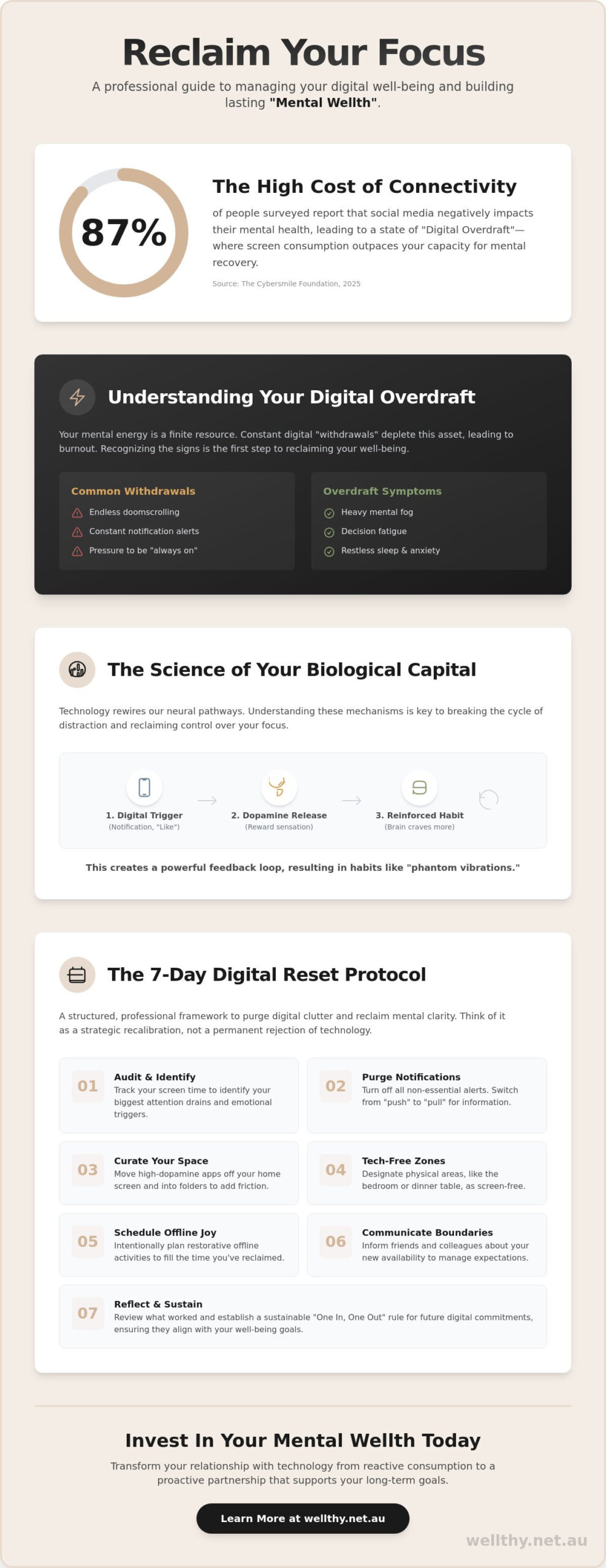
Did you know that 87% of people surveyed report that social media negatively impacts their mental health? (The Cybersmile Foundation, 2025). It’s exhausting to feel like your attention is a currency you’re spending without receiving any dividends in return. You’ve likely felt that heavy mental fog after an hour of doomscrolling or the frustration of a glowing screen being the last thing you see before a restless night’s sleep. We understand that feeling of being “connected” yet deeply isolated from the relationships and moments that truly matter.
Your mental energy is your most valuable asset, and it’s time to manage it with the same intentionality you’d apply to a high-value investment. This guide offers a professional framework and actionable digital detox tips to help you reclaim your focus and reinvest your time into restorative offline experiences. We’ll explore how to leverage new tools like Android’s “Pause Point” feature and navigate the global “Right to Disconnect” movement to establish sustainable boundaries. You’re about to discover how to transform your relationship with technology into a partnership that supports your long-term well-being and clarity.
Key Takeaways
- Learn to identify your “digital overdraft” by auditing your attention to ensure your screen consumption never exceeds your capacity for mental recovery.
- Discover the science behind your biological capital, including how notification loops and blue light impact your focus and sleep quality.
- Build a diverse wellness portfolio using practical digital detox tips that balance daily micro-habits with restorative macro-resets.
- Follow a professional 7-day reset protocol to purge digital clutter and reclaim the mental clarity needed for high-value offline experiences.
- Establish a sustainable “One In, One Out” rule to ensure your future digital commitments always align with your personal well-being goals.
Understanding the Digital Overdraft: Why Your Wellth Depends on Disconnecting
Imagine your mental energy as a sophisticated investment portfolio. Every notification, scroll, and “ping” represents a withdrawal from your most precious asset: your attention. When your screen consumption consistently outpaces your capacity for mental recovery, you enter a state of “Digital Overdraft.” This isn’t just a metaphor. It’s a physiological reality that leaves you feeling bankrupt, foggy, and disconnected. In 2026, the cultural tide has turned. We’re moving away from the exhaustion of constant availability and toward the empowerment of intentional connectivity. By treating your focus as a form of non-monetary capital, you begin to build “Mental Wellth,” a vibrant state of being where your digital life fuels your offline aspirations rather than draining them.
The High Cost of Constant Connectivity
The price of being “always on” is often higher than we realize. In a notification-driven culture, the ability to engage in deep work is often the first casualty. When your brain is constantly scanning for the next update, it loses the capacity to sustain the concentration required for high-level creativity and problem-solving. This constant state of alert leads to decision fatigue, where even simple choices feel overwhelming. For many high-performers, digital burnout manifests in subtle ways. You might find yourself checking your phone for no reason, losing track of time in endless feeds, or feeling a persistent sense of anxiety when you aren’t “connected.” These aren’t personal failings. They’re clear signals that your biological capital is being overspent and your system needs a restorative pause.
What a Digital Detox Is (and Isn’t)
To manage your mental assets effectively, we need a clear understanding of the tools at our disposal. What is a digital detox? It’s not a permanent rejection of technology or a demand to live off the grid. Instead, think of it as a strategic recalibration. It’s a temporary reset designed to lower your dopamine baseline, allowing you to find joy in slower, more meaningful offline activities. We approach technology as a supportive partnership. By implementing tailored digital detox tips, you aren’t fighting your devices; you’re setting boundaries that allow you to thrive. A successful detox helps you transition from reactive consumption to proactive living. It ensures that every digital interaction provides a high return on your investment of time and energy. Use these digital detox tips to build a sustainable relationship with your screens that honors the personhood behind the data.
The Science of Screen Time: How Connectivity Impacts Your Biological Capital
Managing your mental wellth requires a deep understanding of the biological mechanisms at play when you pick up your phone. Every notification or social media “like” triggers a release of dopamine, the neurotransmitter responsible for reward and motivation. This creates a powerful feedback loop. Because these rewards are variable and unpredictable, your brain remains in a state of constant anticipation. This is the same neurological mechanism found in games of chance. Over time, your nervous system becomes so sensitized that you may experience “phantom vibrations,” feeling a phone buzz in your pocket even when it isn’t there. It’s a sign that your biological capital is being diverted toward digital maintenance rather than personal growth.
Neural Pathways and the Dopamine Trap
The habit of checking your device isn’t a character flaw. It’s the result of rewired neural pathways that prioritize immediate, low-value rewards over long-term goals. To break this cycle, you must intentionally “starve the distraction” to feed your focus. One of the most effective digital detox tips is to move high-dopamine apps off your home screen or into folders. This small friction point breaks the automaticity of the behavior. You can also consult a 7-Day Digital Reset Guide to systematically identify which triggers are draining your energy. By reclaiming this “white space,” you give your brain the room it needs to process information and foster genuine creativity. If you’re looking for more ways to optimize your lifestyle, explore our brand partnership packages for tools that support a balanced routine.
Connectivity also impacts your stress levels through “doomscrolling,” the act of endlessly consuming negative news. This behavior keeps your body in a state of chronic sympathetic nervous system activation, flooding your system with cortisol. This stress hormone is useful in short bursts, but chronic elevation erodes your resilience and mental clarity. Your brain needs moments of quiet to transition from a reactive state to a reflective one. Without this downtime, your ability to innovate and solve complex problems diminishes significantly.
Sleep: The Ultimate Wellness Investment
Your sleep quality is perhaps the most significant indicator of your digital health. The blue light emitted by screens suppresses melatonin production, the hormone that signals to your body it’s time to rest. This disrupts your circadian rhythm, making it harder to fall asleep and reducing the quality of the rest you do get. To protect this vital asset, you must establish clear boundaries between your day and night. A digital sunset is a non-negotiable ritual where you power down all screens 60 minutes before bed to protect your sleep hygiene. Avoiding your phone first thing in the morning is equally vital. It allows your natural morning cortisol spike to wake you up naturally, ensuring you start the day with intention rather than reacting to someone else’s agenda. Implementing these digital detox tips ensures your biological capital remains robust and ready for the challenges of 2026.
Micro vs. Macro: Choosing the Best Digital Detox Tips for Your Lifestyle
Building mental wellth isn’t a one-size-fits-all transaction. Think of your digital health as a “Wellness Portfolio” where you diversify your efforts to protect your biological capital. If you’re feeling chronically exhausted or unable to focus, you might be carrying a high level of “Digital Debt.” Choosing the right path depends on whether you need a quick adjustment or a complete structural overhaul. Consistency always beats intensity. A short daily practice often yields higher returns than a single, dramatic retreat once a year. By tailoring your approach to your specific needs, you ensure your digital boundaries are both practical and sustainable.
The Micro-Detox: Daily Dividends
Small, frequent adjustments are the bedrock of a healthy digital lifestyle. These micro-detoxes act like daily dividends, slowly rebuilding your focus without requiring you to disappear from your professional or social life. Start with the 20/20/20 rule to protect your eye health and mental pacing. Every 20 minutes, look at something 20 feet away for 20 seconds. It’s a simple pause that signals to your brain that it’s safe to disengage from the screen. Establishing “Phone-Free Zones” in your home, such as the dining table or the bedroom, creates physical boundaries that reinforce your mental ones. For an immediate change in how you perceive your device, try switching to greyscale mode. By removing the vibrant, candy-coated colors designed to keep you clicking, you make your apps significantly less addictive. These digital detox tips are easy to implement but offer profound long-term benefits for your clarity and presence.
The Macro-Detox: The Deep Reset
Sometimes, a portfolio needs a deeper rebalance. A macro-detox, like a “Digital Blackout” weekend, allows your dopamine receptors to fully recalibrate. The key to success here is preparation rather than deprivation. Communicate your absence to colleagues and family ahead of time to reduce the “FOMO” or social anxiety that often accompanies disconnection. This is particularly relevant now that at least 15 countries, including Australia and Ireland, have established a legal “right to disconnect” as of May 2026. Use this time to reinvest in high-value offline experiences. You might explore local mindfulness practices or spend time in nature to ground your nervous system. By stepping away entirely for 48 hours, you gain a fresh perspective on which digital habits are serving you and which are simply draining your energy. This deep reset isn’t about escaping reality. It’s about returning to it with a renewed sense of purpose. Implementing these digital detox tips on a larger scale provides the structural support your mental wellth deserves.
The 7-Day Digital Reset: A Step-by-Step Guide to Reclaiming Your Focus
Reclaiming your focus isn’t a matter of willpower. It’s a matter of strategy. To move from a state of digital overdraft to one of mental wellth, you need a structured timeline that allows your nervous system to adjust. This 7-day reset is designed to be a supportive partnership between your goals and your daily habits. By following these digital detox tips, you won’t just be “quitting” apps. You’ll be auditing your time and reinvesting it into high-value experiences that offer a genuine return on your attention.
Phase 1: The Digital Audit (Days 1–3)
The first three days are about transparency and boundary setting. Start by checking your screen time metrics to identify your primary “time-leaks.” You might be surprised to find how many hours are lost to passive consumption. Once you’ve identified the culprits, turn off all non-human notifications. If a notification isn’t from a real person trying to reach you, it doesn’t deserve a seat at your table. Move your “infinite scroll” apps off the home screen and into hidden folders to break the cycle of automatic opening. For Android users, this is the perfect time to activate the “Pause Point” feature, which adds a 10-second delay before opening distracting apps. This small friction point encourages more intentional use and helps you reclaim your biological capital.
Phase 2: Reclaiming the Analogue (Days 4–7)
As you move into the second half of the week, the focus shifts from what you’re stopping to what you’re starting. Replace your morning scroll with journaling for mental clarity. This practice allows you to set your own agenda before the world’s noise intervenes. Dedicate blocks of time to “Single-Tasking” sessions, where you focus on one activity without the presence of a secondary device. This slowly rebuilds your attention span and reduces the anxiety associated with constant multitasking. Day 7 serves as the benchmark for your new “normal,” providing a clear vision of the mental clarity you can maintain when your digital habits are aligned with your values. If you’re ready to further optimize your lifestyle, consider exploring our sponsored article placement options to discover more professional wellness insights. These digital detox tips are your foundation for a sustainable, focused 2026.
Beyond the Detox: Investing in a Sustainable Digital Relationship
A successful reset is just the beginning of your journey toward lasting mental wellth. The real value lies in the transition from a temporary pause to a sustainable digital lifestyle that consistently serves your professional and personal goals. Think of this as moving from an emergency savings plan to a long-term investment strategy. To prevent digital creep, implement the “One In, One Out” rule. Before you download a new app or sign up for a digital commitment, you must remove an existing one. This ensures your digital portfolio remains lean and purposeful, preventing the clutter that leads back to mental fog. Scheduling regular “Attention Audits” every month allows you to review your screen time metrics and adjust your boundaries before they erode. These ongoing digital detox tips help you maintain the clarity you’ve worked so hard to reclaim.
Building Your Analogue Toolkit
Replacing digital habits with physical alternatives is a powerful way to protect your biological capital. Invest in a physical alarm clock to keep your phone out of the bedroom; this ensures your digital sunset remains a sacred ritual. A paper planner offers a tactile experience that screens cannot replicate, helping you visualize your day without the risk of notification-driven distractions. We also encourage you to embrace “High-Touch” hobbies that ground you in the physical world. Whether it’s the sensory experience of cooking a complex meal or visiting a day spa for a deep reset, these activities provide a level of restorative value that digital consumption never will. Finally, curate your digital feeds with the same care you’d use for a fine art collection. Ensure every account you follow provides genuine inspiration rather than just mindless stimulation.
Final Thoughts: Your Wellth is Your Attention
Your attention is a finite resource, and how you spend it determines the quality of your life. By viewing your screen time as a budget, you become the disciplined manager of your own well-being. Digital boundaries aren’t restrictions; they’re the protective walls that allow your creativity and relationships to flourish. We’ve explored how a professional framework and practical digital detox tips can reduce fatigue and improve sleep quality. Now, the choice to reinvest that energy into your offline life is yours. At Wellthy, we’re committed to being your partner in this journey toward a more balanced and inspired existence. Join our community for ongoing inspiration and professional insights as you continue to build your mental wellth in 2026.
Reclaiming Your Attention Portfolio
Your journey toward mental wellth is an ongoing commitment to valuing your own personhood over digital noise. By auditing your “digital overdraft” and implementing the digital detox tips we’ve discussed, you’re shifting from a reactive consumer to a deliberate manager of your biological capital. Focus is a finite asset. Every boundary you set is a direct investment in your long-term clarity and sleep quality. You now have the professional framework to maintain a sustainable relationship with technology that supports, rather than drains, your vibrant lifestyle.
As you move forward, look for opportunities to reinvest your reclaimed time into high-value offline experiences. Trusted by wellness enthusiasts across Australia, Wellthy provides expert-led insights into holistic health and actionable guides for modern professionals. We invite you to join the Wellthy community for more tips on investing in your lifestyle capital. You deserve to thrive in a world that respects your right to disconnect. Stay intentional, remain patient with your progress, and enjoy the profound sense of calm that comes with being truly present in your own life.
Frequently Asked Questions
How do I do a digital detox when I work online?
You can detox effectively by creating strict compartmentalization between your professional tasks and your personal time. Use the “Focus” modes on your operating system to silence non-essential pings during work hours. Once you finish your professional duties, physically store your work devices away to signal to your brain that the “always-on” period has ended. This creates a clear boundary that protects your mental recovery without compromising your career.
Can a digital detox really improve my mental health in just a few days?
Significant improvements in mental clarity and stress levels often appear within just 48 to 72 hours of reduced screen use. This short window allows your cortisol levels to stabilize and your brain to begin recovering from constant dopamine overstimulation. While a few days provides a restorative boost, the most lasting benefits come from integrating these digital detox tips into your weekly routine as a permanent lifestyle investment.
What are the most effective digital detox tips for beginners?
The most effective way to start is by introducing small friction points that break the cycle of automatic phone use. Try charging your device in a completely different room at night to ensure your morning starts with reflection rather than a screen. You can also turn off all non-human notifications. This ensures that only messages from real people can interrupt your focus, instantly reducing the “noise” in your daily life.
How long should a digital detox last to see real results?
You will likely notice a shift in your focus after just 24 hours, but a 7-day period is ideal for breaking deep-seated habits. A week-long commitment provides enough time for your nervous system to recalibrate and for you to establish new, healthier patterns. The goal isn’t just a temporary break. It’s about a permanent rebalance of your attention portfolio to ensure you’re earning a high return on your mental energy.
Is it better to delete social media apps or just set time limits?
Deleting apps is often the superior choice for those struggling with high “Digital Debt” because it removes the temptation entirely. If you find yourself mindlessly opening social media, the extra step of logging in via a browser creates a helpful moment of pause. If you’ve already established strong boundaries, setting strict app timers can serve as a gentle reminder to reinvest your time into high-value offline experiences instead.
What should I do if I feel anxious during my digital detox?
Anxiety is a common and natural response to the sudden removal of digital stimulation. When this happens, lean into “analogue” activities that engage your senses, such as going for a walk, cooking, or practicing deep breathing. Recognizing that this discomfort is simply your brain recalibrating its dopamine baseline can help you stay the course. Treat these moments with empathy rather than judgment as your system returns to balance.
How can I stay committed to my digital boundaries in the long term?
Staying committed requires you to treat your digital habits as a dynamic portfolio that needs regular oversight. Schedule a monthly “Attention Audit” to review your usage and ensure your apps still align with your personal goals. By applying digital detox tips consistently, you transform these boundaries from a temporary challenge into a vibrant and sustainable lifestyle. This ongoing partnership with your technology ensures your wellth remains protected year-round.