
You’re tired, the house is quiet, and the second your head hits the pillow your brain starts its night shift. It runs through tomorrow’s meetings, that awkward comment from lunch, the unread email you forgot, the family thing you still haven’t resolved. You know sleep would help. You just can’t get your mind to stop arguing with itself.
In clinic, this is one of the most common complaints I hear from busy Australians. Not “I’m not tired”, but “I’m exhausted and my mind won’t switch off”. That distinction matters. Night-time overthinking isn’t usually a motivation problem. It’s a pattern involving stress, timing, habit, and a nervous system that hasn’t had a clean runway into sleep.
If you want to know how to stop overthinking at night, vague advice like “just relax” won’t cut it. You need tools for the moment, routines that lower the odds of a spiral, and a few long-term strategies that train your brain to stop treating bedtime like a board meeting.
Table of Contents
- Why Your Brain Goes into Overdrive After Dark
- Immediate Tools to Quiet Your Mind Tonight
- Design Your Pre-Sleep Wind-Down Routine
- Long-Term Strategies to Rewire Nighttime Worry
- Troubleshooting and When to Seek Professional Support
- Your Sustainable Path to Calmer Nights
Why Your Brain Goes into Overdrive After Dark
At 3 am, thoughts feel louder than they do at 3 pm. That’s not because your worries suddenly became wiser. It’s because night strips away distraction, fatigue weakens perspective, and the brain becomes less effective at sorting real priorities from emotional noise.
For many people, the day runs on action and suppression. You answer messages, commute, make dinner, get through the list. Then you finally stop moving, and all the postponed thinking rushes in at once. Your brain treats silence like an invitation to process unfinished business.
In Australia, approximately 35% of adults report experiencing significant sleep disturbances due to nighttime overthinking and anxiety, rising to 45% among busy professionals in urban centres like Sydney and Melbourne, according to data cited here. If this is happening to you, you’re not broken, weak, or “bad at sleeping”. You’re dealing with a common stress response.
The tired but wired pattern
The simplest way to understand it is this. At night, your logical brain is tired, but your alarm system may still be active. When people are under pressure for long stretches, cortisol rhythms can stay too high too late. You feel spent, yet internally alert.
That’s why trying to “think your way out” of overthinking often fails. The part of you trying to reason calmly is not at full strength. The emotional brain is quicker, louder, and more dramatic after dark.
Night-time worry often feels urgent. Usually it isn’t urgent. It just arrives when your brain is least equipped to assess it properly.
Why Australian conditions can make it worse
Generic sleep advice often ignores local context. In clinic, I see this often with Queensland clients during hot, sticky nights, and with professionals in major cities who spend all day under artificial light and all evening on screens. Heat, long workdays, late device use, and irregular light exposure all make it harder for the body to recognise that sleep is supposed to happen soon.
That’s why the answer to how to stop overthinking at night isn’t a single hack. It’s better timing, better cues, and less friction between your body clock and your lifestyle.
Immediate Tools to Quiet Your Mind Tonight
When your mind is racing in bed, don’t negotiate with every thought. Use a short intervention that shifts your physiology or your attention. You need something simple enough to do when you’re tired and annoyed.
Use your body to calm your brain
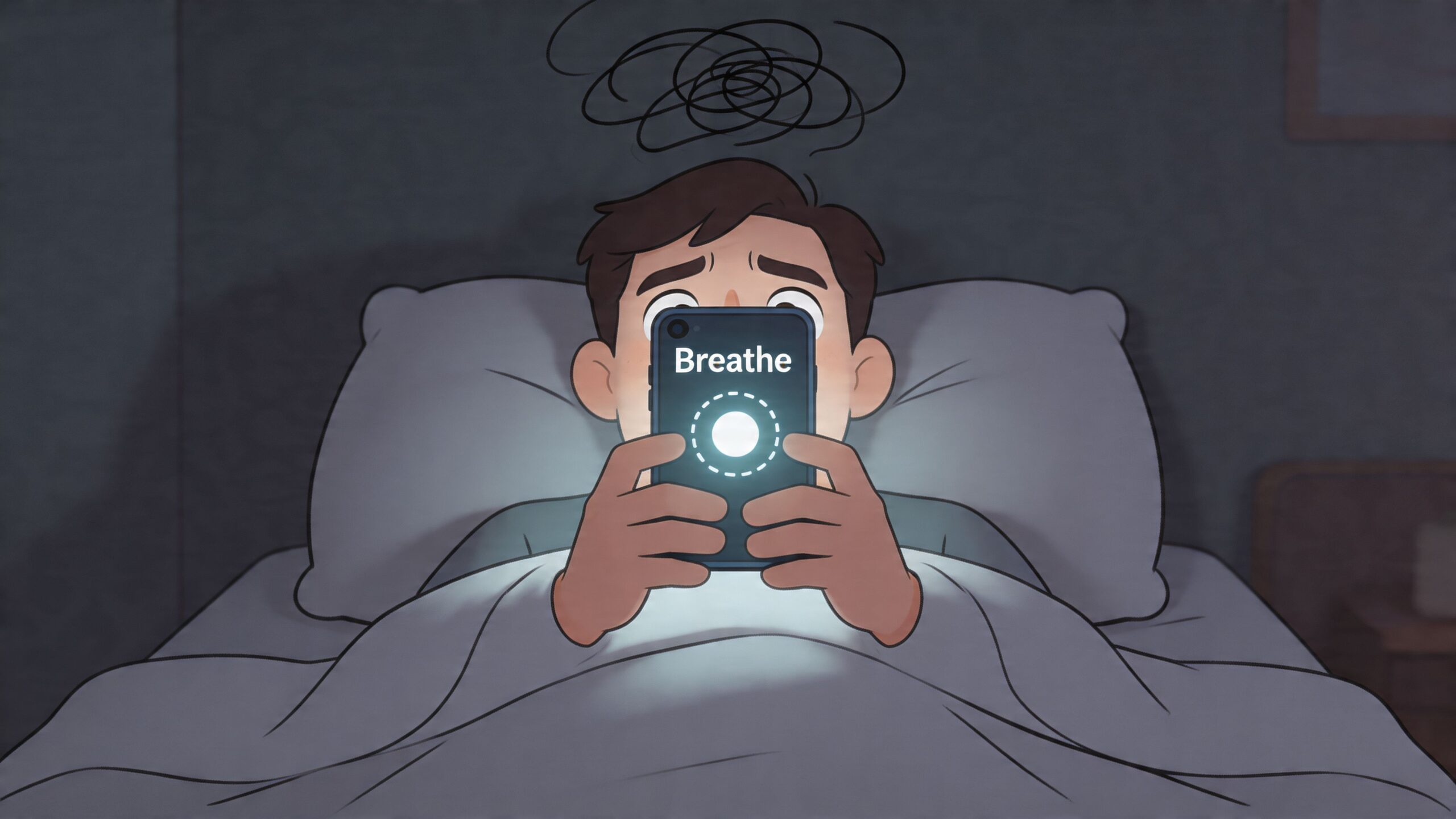
Start with 4-7-8 breathing. A Black Dog Institute trial found that this technique, practised nightly, decreased wake-after-sleep-onset by 37% and enabled 71% of participants to fall asleep within 15 minutes, as noted in this summary of the trial.
Use it like this:
- Breathe in through your nose for 4.
- Hold for 7.
- Exhale slowly for 8.
- Repeat for a few rounds without trying to force sleep.
This works best when your exhale is soft and unhurried. If the count feels stressful, shorten it slightly. The point is a slower exhale, not perfect performance.
Practical rule: If a breathing exercise makes you feel like you’re “doing sleep homework”, simplify it. Calm beats precision.
Interrupt the mental spiral with sensory grounding
If your thoughts are abstract and repetitive, use the 5-4-3-2-1 grounding method. It gives your brain a task that is concrete and non-threatening.
Try this in bed:
- 5 things you can see. Shadows, the curtain edge, the charger, the ceiling line, the bedside table.
- 4 things you can feel. Sheets on your legs, pillow under your neck, air on your skin, your hands resting.
- 3 things you can hear. A fan, distant traffic, your breath.
- 2 things you can smell. Clean linen, night air, hand cream.
- 1 thing you can taste. Even a neutral taste counts.
This won’t erase anxiety in one pass. It changes the channel. That’s enough to interrupt momentum.
Ask one useful question
The third tool is cognitive, but keep it blunt: “Is this thought productive right now?”
Not true or false. Not important or unimportant. Productive right now.
If the answer is no, follow with one of these lines:
- “This can wait until daylight.”
- “I don’t need to solve this in bed.”
- “Thinking harder isn’t helping.”
That phrasing matters. People who overthink at night often keep trying because part of them believes more thinking will create relief. Usually it creates arousal. Bed is for sleep, not strategy.
A quick comparison helps:
| Situation | What usually doesn’t work | What works better |
|---|---|---|
| Racing thoughts about work | Rehearsing tomorrow in detail | One line on paper, then return to breath |
| Replaying conversations | Analysing motives for 40 minutes | Grounding through senses |
| Fear about not sleeping | Watching the clock | Slow exhale and no time-checking |
If you try one tool and it doesn’t click, switch. Don’t lie there grading yourself.
Design Your Pre-Sleep Wind-Down Routine
Good sleep starts before bed. Most overthinkers wait until their mind is already spinning, then try to fix it from the pillow. That’s late. A wind-down routine works because it lowers mental and sensory load before the spiral begins.
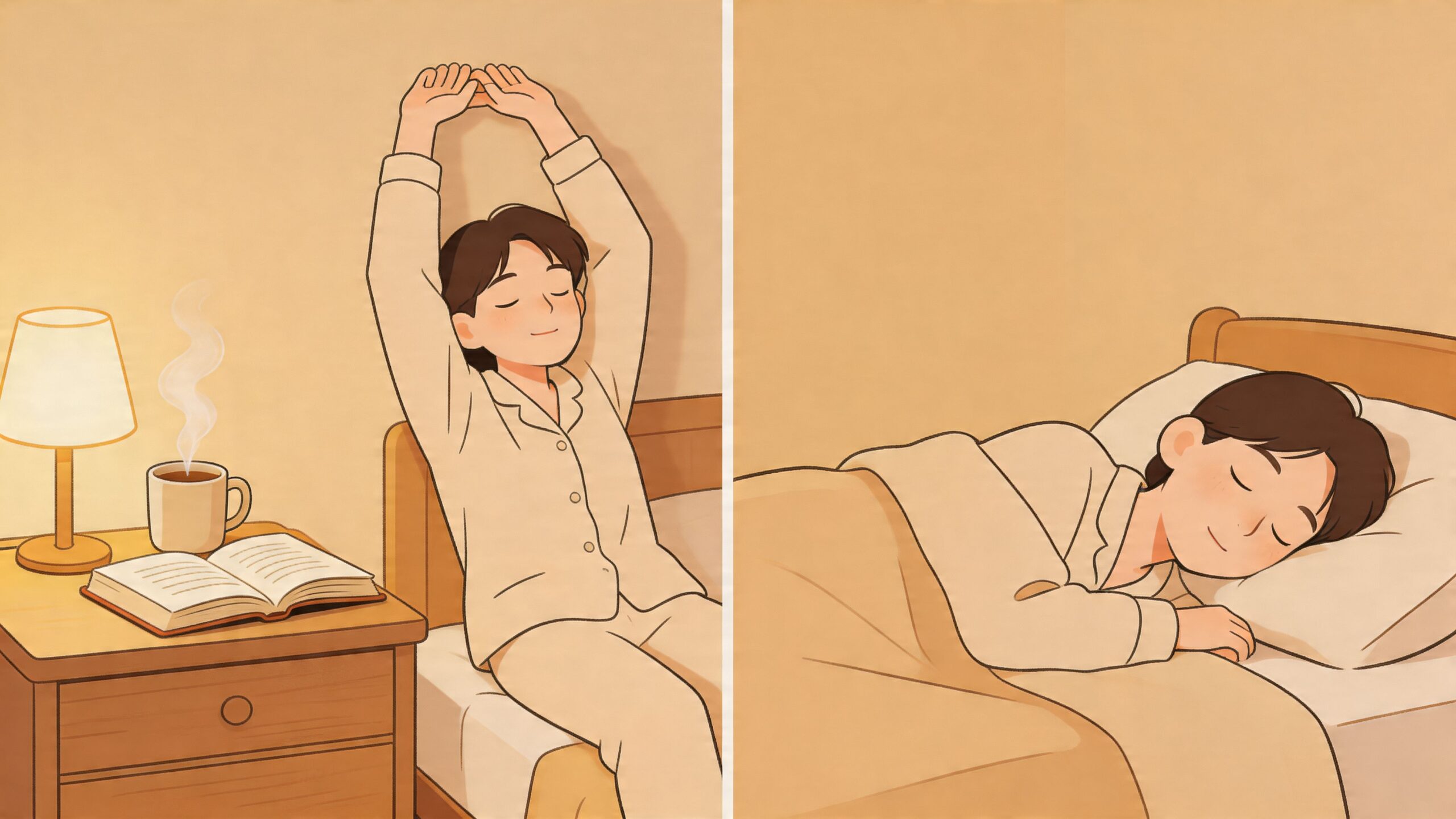
A pre-sleep ritual doesn’t need to be fancy. It needs to be repeatable. One study found that implementing a pre-sleep wind-down ritual, such as dimming lights and avoiding screens one hour before bed, reduced overthinking episodes by 42% over 8 weeks. That matters because the brain responds well to consistent cues, not random acts of self-care.
Build a sleep-friendly hour
Think of the last hour before bed as protected low-stimulation time. You’re not trying to be perfect. You’re creating a gentler landing.
A practical wind-down hour often includes:
- A digital sunset. Lower screen exposure, stop doom-scrolling, and avoid emotionally loaded content. If this is your weak spot, this piece on digital detox benefits and tips gives realistic ways to reduce evening stimulation without going off-grid.
- Dimmer light. Use lamps instead of overhead lights where possible.
- A brief brain dump. Write tomorrow’s top tasks and any unresolved worries. Keep it short. You are unloading, not journalling your autobiography.
- Gentle movement. Stretching, slow mobility work, or a slow walk around the block can release some of the physical tension that keeps the mind activated.
- A non-caffeinated cue. Many Australians do well with a simple cup of herbal tea. Lemon myrtle or chamomile can become part of the routine because the ritual itself is calming.
For a broader refresher on basics, this guide to sleep hygiene is useful because it frames sleep as a set of habits, not a single bedtime trick.
Make the routine fit Australian evenings
The best routine is the one you’ll still do during a humid Brisbane summer, after a long commute in Melbourne, or when daylight lingers and dinner runs late. Local conditions matter.
If you live somewhere hot, don’t ignore temperature. A cool shower, breathable sleepwear, and a cooler bedroom often do more than another meditation track when heat is part of the problem. If you’ve been under harsh office lighting all day, getting some natural light earlier in the morning can also help anchor your rhythm by the evening.
Here’s a workable version for a busy professional:
| Time | Action | Why it helps |
|---|---|---|
| 60 minutes before bed | Put phone on charge outside reach | Reduces easy re-entry into work or news |
| 45 minutes before bed | Dim lights and lower noise | Gives the brain a clear environmental cue |
| 30 minutes before bed | Write a short to-do list for tomorrow | Stops mental rehearsal in bed |
| 15 minutes before bed | Stretch, breathe, or read something undemanding | Lowers arousal without effort |
If you want a guided visual reset, this short practice can fit neatly into that final part of the evening:
What doesn’t work well? Intense exercise too late, “just one more” email, alcohol as a sedative, or collapsing into bed straight from a bright, noisy screen. Those habits can make you sleepy for a moment while keeping your nervous system more activated than it appears.
Long-Term Strategies to Rewire Nighttime Worry
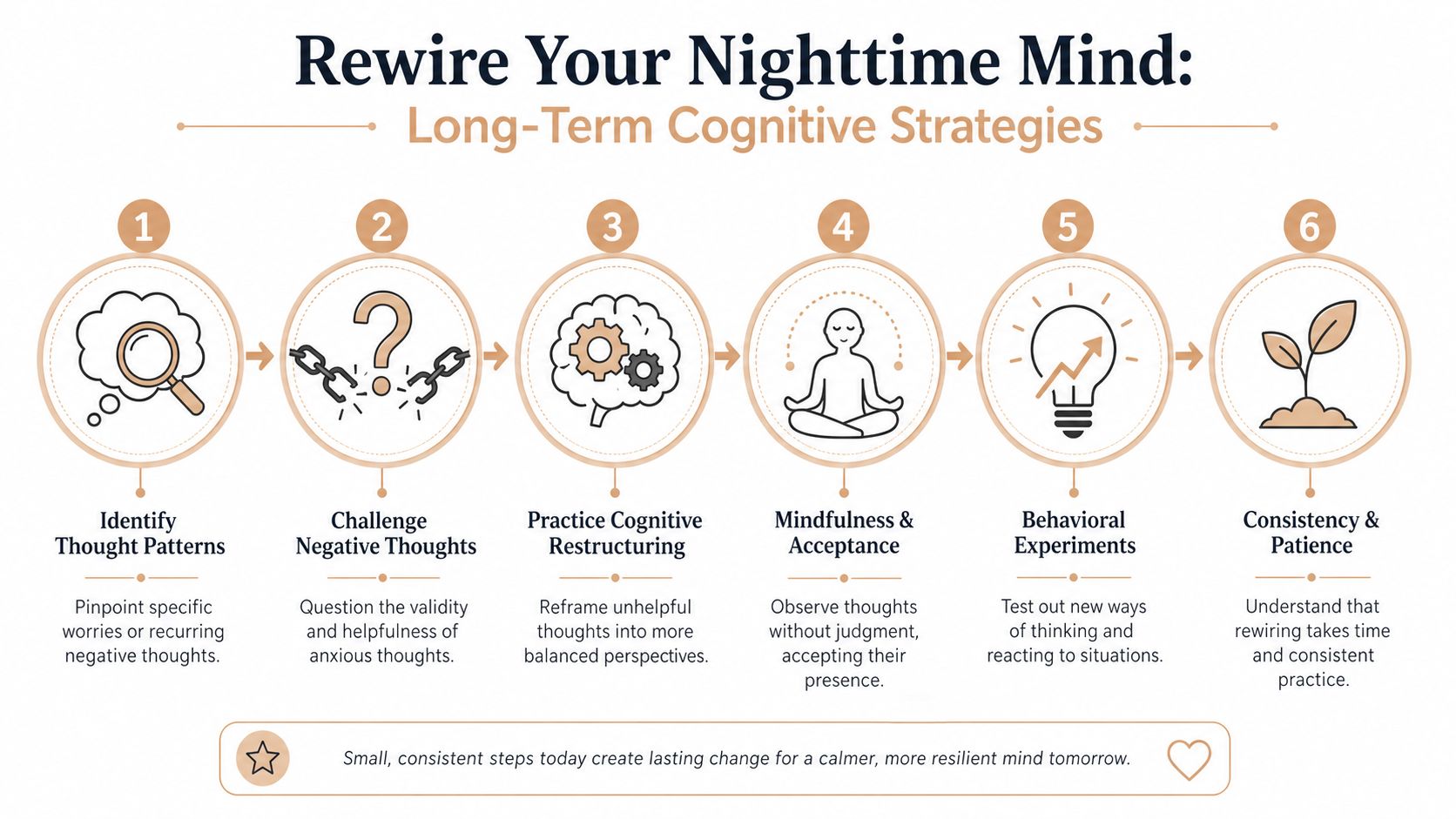
If overthinking has become your default bedtime pattern, you need more than relief. You need retraining. The aim isn’t to stop having thoughts. The aim is to stop letting bedtime become the daily collection point for every unresolved worry.
Use a worry window, not all-night worry
The Worry Window is one of the most practical cognitive strategies I recommend. Instead of trying not to worry, you schedule worry earlier in the evening and contain it.
A Queensland Health trial involving busy professionals found that the technique had a 78% success rate in reducing sleep onset latency by 25 minutes, according to this overview of the Worry Window technique.
Do it like this:
- Pick a regular slot well before bed. Early evening works better than late evening.
- Set a timer for 15 to 20 minutes.
- Write down what’s on your mind.
- Separate each worry into one of three buckets: actionable, uncertain, or not controllable.
- For actionable items, write the next step.
- Close the notebook when time is up.
The closing part matters. It tells the brain the task has been handled for now.
If a thought returns in bed, don’t reopen the case. Use one line: “Not now. Tomorrow during worry time.”
Practise mindfulness as a skill, not a vibe
Mindfulness helps, but many people misunderstand it. It’s not trying to empty your mind. It’s learning to notice thoughts without climbing into each one.
That sounds simple. It takes practice.
A good starter version looks like this:
- Sit or lie comfortably.
- Notice the breath moving in and out.
- When a thought appears, label it lightly. “Planning.” “Remembering.” “Worrying.”
- Return to the breath or to body sensations.
That shift, from merging with a thought to observing it, is powerful over time. If you want a grounded overview of why this helps anxious minds, this article on the science-backed benefits of mindfulness for anxiety is worth reading.
For some readers, complementary routines can help create a calmer evening container. This roundup of wellness tips for deep sleep can offer a few sensory cues to pair with the cognitive work.
What works versus what usually backfires
Long-term progress depends on choosing the right mental stance. Here’s the trade-off many overthinkers miss:
| Approach | Result |
|---|---|
| Trying to suppress every thought | Thoughts often rebound harder |
| Analysing the same fear repeatedly | Feels productive, usually increases arousal |
| Scheduling structured worry time | Builds containment |
| Noticing thoughts without arguing | Builds distance |
| Expecting instant mastery | Leads to frustration and quitting |
| Repeating small practices consistently | Builds trust and familiarity |
The challenge isn't usually a lack of insight into why one worries. It's establishing stronger boundaries around when worry gets airtime.
Troubleshooting and When to Seek Professional Support
Some nights will still be messy. That doesn’t mean the method failed. It usually means one of three things happened. You started too late, you expected a tool to work instantly, or your stress load is high enough that self-guided strategies need backup.
Common reasons good techniques seem to fail
Breathing doesn’t work well if you use it only after forty minutes of panic. Journalling can backfire if it turns into problem-solving at 11:30 pm. Mindfulness can feel irritating at first if you secretly use it to force thoughts away.
The fix is usually adjustment, not abandonment.
- If breathing feels frustrating, shorten the count and focus on a longer exhale.
- If journalling wakes you up, keep it to dot points only.
- If you keep reaching for your phone, put it physically farther away before bed.
- If stress is spilling through the whole day, look beyond night-time tactics and support your nervous system earlier.
For some people, broader stress support can be part of that picture. If you’re exploring options, this guide to a supplement for stress can help you think more clearly about where supplements may or may not fit alongside sleep habits.
Some tools fail because they’re bad. More often, they fail because people apply them too late, too intensely, or too inconsistently.
Signs it’s time to get help
Professional support is worth considering if:
- Sleep problems keep showing up for weeks and your daytime functioning is suffering.
- You dread bedtime because you expect another mental battle.
- Overthinking at night is tied to strong daytime anxiety or low mood.
- You’re relying on alcohol, late-night scrolling, or erratic routines just to get through the evening.
- Your relationships, concentration, or work performance are taking a hit.
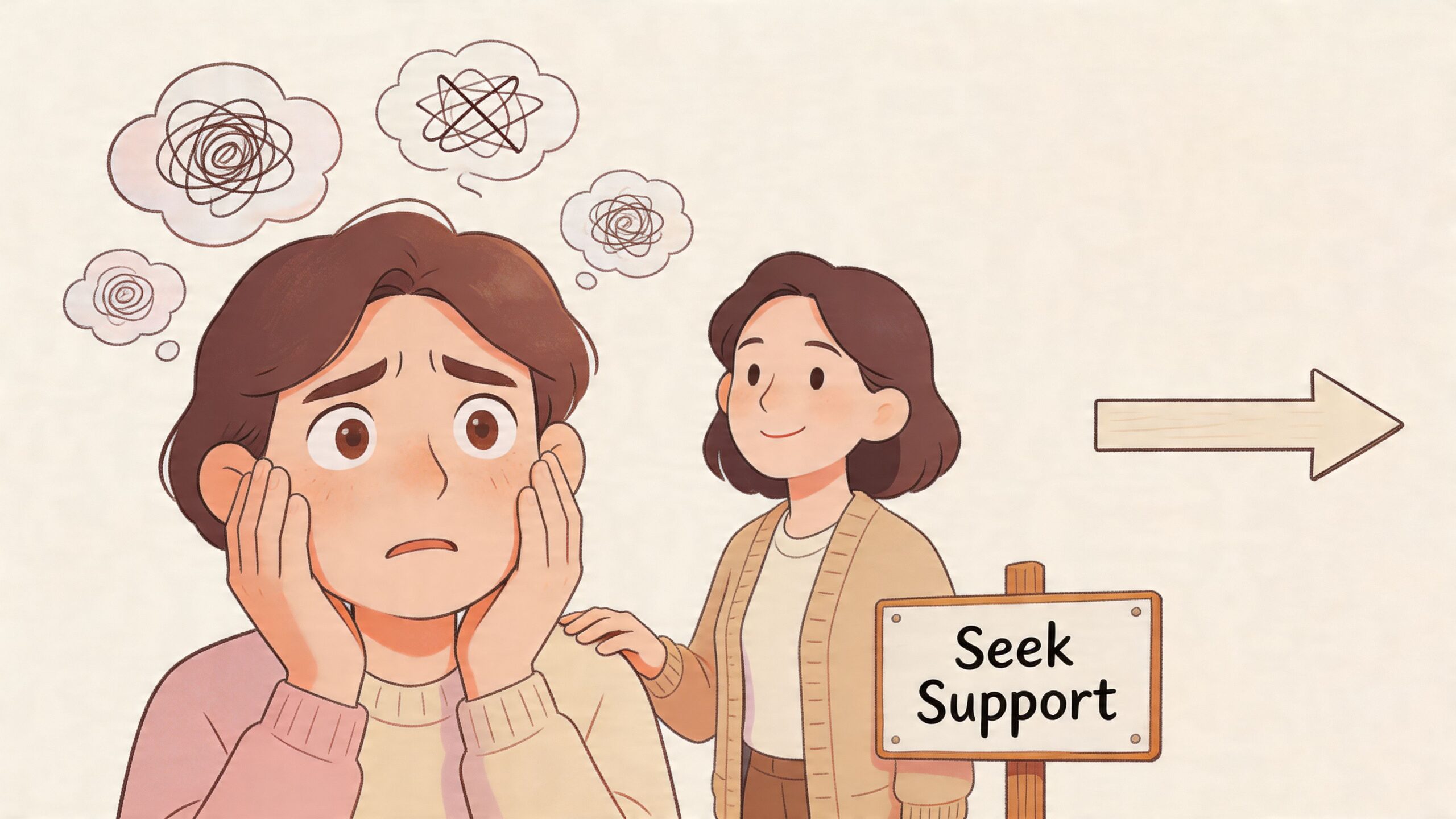
In Australia, start with your GP. Be specific. Say how often it happens, how long it’s been going on, what you’ve tried, and how it affects your day. If needed, ask about referral options for CBT-I, which is the structured treatment many sleep clinics use for persistent insomnia patterns.
Your Sustainable Path to Calmer Nights
If you want to know how to stop overthinking at night, think in layers. Use immediate tools when your mind is racing. Build a wind-down routine that lowers the chance of a spiral. Practise long-term strategies like the Worry Window and mindfulness so bedtime stops carrying the full emotional load of your day.
The goal isn’t a perfectly blank mind. That’s not realistic. The goal is a steadier night routine, less mental urgency after dark, and a brain that learns bed is for rest rather than review.
That’s the bigger idea behind building wellth. Calmer nights aren’t just about sleep. They support clearer thinking, better mood, steadier energy, and stronger performance the next day. Small changes compound.
If you want extra reading, this collection of natural sleep improvement tips is a useful complement to the strategies above.
A few Australian resources worth keeping handy:
- Sleep Health Foundation for plain-English sleep advice
- Beyond Blue if worry, anxiety, or low mood is part of the picture
- Smiling Mind for Australian-made guided mindfulness support
- Your GP or a local sleep clinic if overthinking has turned into ongoing insomnia
Start with one tool tonight, not ten. Consistency beats intensity.
Wellthy shares practical, Australia-focused guidance to help you build better sleep, steadier energy, and long-term mental wellth. If you want more evidence-informed wellness strategies you’ll apply, explore Wellthy.
Crafted with Outrank tool