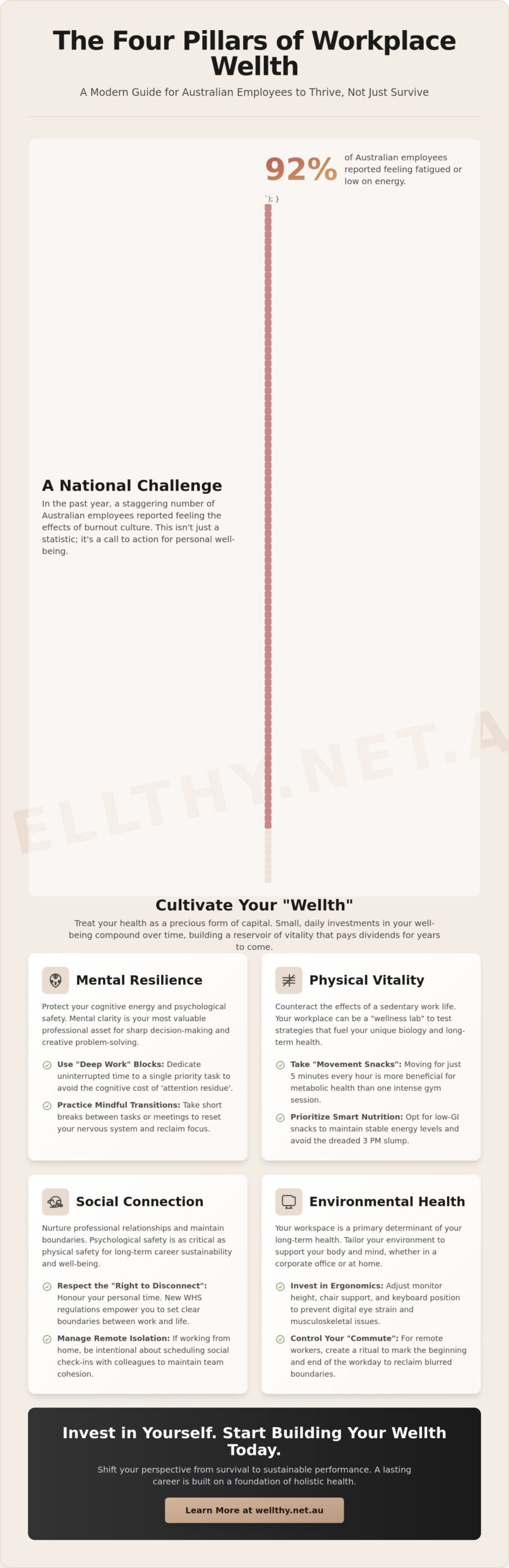
Did you know that 92% of Australian employees reported feeling fatigued or low on energy in the past year? If you have felt the heavy fog of digital eye strain or the frustration of blurred boundaries in your hybrid office, you are certainly not alone. It’s common to feel that the modern Australian “always-on” culture is a constant withdrawal from your personal energy rather than an investment in your future.
We have designed this guide to provide actionable workplace wellness tips for employees australia that transform your daily routine into a source of vitality. You’ll learn how to build “wellth,” treating your health as a precious form of capital that deserves disciplined oversight and genuine care. This isn’t about temporary fixes or corporate perks; it is about a personalized strategy for long-term well-being.
We will explore sustainable micro-habits to beat the 3 PM slump and explain how the 2026 WHS regulations on psychosocial hazards empower you to reclaim your right to disconnect. From managing sedentary fatigue to sharpening your mental clarity, these strategies ensure your professional life supports the human being behind the screen.
Key Takeaways
- Understand how to cultivate “Wellth” by making small, daily health choices that compound like financial interest for your long-term vitality.
- Discover how to protect your cognitive energy and psychological safety by applying the four pillars of modern workplace wellth.
- Learn actionable workplace wellness tips for employees australia to manage digital eye strain and reclaim your focus during the busiest hours of the day.
- Adapt your wellness routine to suit your specific environment, whether you are managing the isolation of remote work or the demands of a corporate office.
- Shift your perspective to view your professional life as an investment in yourself, ensuring you remain a person first and an employee second.
What is Workplace Wellness in the Modern Australian Context?
Workplace wellness has evolved far beyond the outdated “perks” of a decade ago. The 2026 Australian landscape reflects a deep integration of your physical, mental, and social health within your professional sphere. It’s about recognizing that your work shouldn’t just be something you survive; it should be a platform where you thrive. We call this “Wellth.” Just like financial capital, your health choices compound over time. A single walk or a dedicated hour of deep focus might seem small, but these daily investments build a reservoir of vitality that pays dividends for years to come.
The 2026 workforce has pivoted toward a more holistic, employee-led model of wellbeing. This shift is mirrored in our legal frameworks. The Fair Work Commission has increasingly solidified the “right to disconnect,” acknowledging that psychological safety is just as critical as physical safety. This modern view aligns with broader Occupational health standards, ensuring that your professional life doesn’t infringe upon your fundamental human need for rest and recovery.
Why Your Professional Environment is a Health Determinant
Think about your standard 38-hour work week. Over a lifetime, that is roughly 90,000 hours spent at a desk, in a studio, or on a site. This makes your workplace a primary determinant of your long-term physiological health. High workplace stress doesn’t stay at the office; it follows you home, disrupting your sleep quality and influencing poor nutritional choices. Instead of seeing the office as a source of fatigue, try viewing it as a “wellness lab.” It’s a controlled environment where you can test workplace wellness tips for employees australia, such as ergonomic adjustments or scheduled hydration, to see what fuels your unique biology.
The Shift from Survival to Thriving at Work
The era of “hustle culture” has been replaced by a focus on sustainable performance. Australian professionals are realizing that burning out isn’t a badge of honor; it’s a structural failure. Today, mental clarity is your most valuable asset. It allows for sharper decision-making and more creative problem-solving. Building a foundation of holistic health is no longer a luxury for the weekend; it’s the core requirement for a lasting career. By prioritizing these workplace wellness tips for employees australia, you move from a state of constant recovery to a state of proactive growth where you can truly excel.
The Four Pillars of Workplace Wellth for Employees
Think of your professional well-being as a diversified investment portfolio. Just as you would manage your tangible assets through specialized platforms like V8Loans to maintain financial flexibility, you shouldn’t rely on just one aspect of your health to carry you through a career. True resilience is built upon four distinct pillars: mental, physical, social, and environmental. When you balance these, you create a sustainable foundation for “Wellth” that grows over time. By intentionally managing these areas, you ensure that your work life remains a source of energy rather than a drain on your resources.
Mental Resilience and Cognitive Boundaries
Protecting your mental capital is essential in the high-pressure Australian corporate world. We often fall into the trap of jumping between tasks, which leads to “attention residue.” This is the cognitive cost of leaving one unfinished task for another. You can combat this by using “deep work” blocks to focus on a single priority without interruption. Incorporating mindfulness into your transition periods can help reset your nervous system. Organizations like the Black Dog Institute offer excellent frameworks for understanding how to maintain this psychological safety and mental clarity during stressful periods.
Physical Vitality and the Sedentary Challenge
Physical wellth is about more than just a gym membership. For the Australian desk-bound professional, the greatest challenge is often sedentary fatigue. One of the most effective workplace wellness tips for employees australia is the “Movement Snack” concept. Research indicates that moving for just 5 minutes every hour is more beneficial for your metabolic health than a single, intense gym session at the end of the day. Pair this with ergonomic essentials, like an adjustable monitor height, and nutritional strategies that prioritize low-GI snacks to keep your blood sugar stable. Small adjustments to your physical workspace can prevent the chronic aches that often lead to long-term burnout.
Social and environmental wellth are the final pieces of the puzzle. Social wellth involves building social capital by fostering genuine connections with your team, which acts as a buffer against workplace stress. Environmental wellth is about curating your physical surroundings to reduce sensory overwhelm, whether that is through noise-canceling headphones or better lighting. If you want to see how these pillars can be integrated into a broader professional strategy, you can explore our brand partnership packages to discover how we support healthy workplace cultures. By addressing all four pillars, you treat yourself as a whole person, ensuring you have the vitality to thrive both in and out of the office.
Navigating the Hybrid Divide: Tailoring Wellness to Your Workspace
By 2026, the Australian professional landscape has firmly settled into a hybrid rhythm. This flexibility is a powerful asset for your personal “Wellth,” but it requires a nuanced approach to maintain balance. The challenges you face in a bustling corporate hub are vastly different from those in a solo home sanctuary. To truly thrive, you must adapt your workplace wellness tips for employees australia to fit the specific sensory and social demands of your current environment. Whether you are managing the overstimulation of an open-plan office or the quiet isolation of remote work, intentionality is your best investment strategy.
Integrating a structured approach, such as the one outlined in the Australian evidence-based workplace wellness framework, allows you to move beyond basic safety checks. It encourages a shift toward proactive health management that considers both psychological and physical needs. When your office is also your living room, the lack of a physical boundary can lead to a state of being “always on.” Setting firm digital boundaries is not just about productivity; it’s about protecting your human right to rest and ensuring your home remains a restorative space.
Optimising the Corporate Office Experience
Major Australian hubs often feature open-plan offices that can lead to a significant sensory load. To protect your cognitive energy, identify “pockets of peace” throughout your day. These are small windows for regulated breathing or a short walk away from your desk to reset your nervous system. If your office is centrally located, take advantage of the local amenities. For instance, those working in the northern capital can leverage the various fitness opportunities nearby to transform a lunch break into a restorative physical deposit. These moments of movement help clear the “attention residue” mentioned earlier, ensuring you return to your tasks with renewed focus.
The Home Office: Mastering the Solo Sanctuary
While the home office offers autonomy, it frequently suffers from neglected ergonomics and the “loneliness epidemic.” Without the natural social capital built through office interactions, you must be more deliberate about connection. Schedule virtual coffee dates or work from a local community space to maintain your social wellth. Equally important is your physical setup. Ensure your space has ample natural light and ventilation to support long-term productivity. Finally, create a clear transition ritual to signal the end of your workday. A simple 15-minute walk can serve as a “fake commute,” helping your brain switch from professional output to personal recovery. This small act ensures your home remains a place of restoration rather than a secondary boardroom.
Actionable Micro-Habits for a Balanced Australian Workday
Sustainable change doesn’t happen through grand gestures. It happens in the small, repeated choices you make between 9 AM and 5 PM. These micro-habits are the compound interest of your professional life. While many guides offer vague advice, these specific workplace wellness tips for employees australia are designed to fit into your existing 38-hour week without adding to your workload. By focusing on tiny, manageable shifts, you can protect your energy and maintain high performance throughout the year.
Start with the “Golden Hour.” Dedicate the first 60 minutes of your day to high-value intention rather than reacting to notifications. This protects your mental capital before the digital noise begins. In our tech-heavy environments, use the 20-20-20 rule to combat eye strain: every 20 minutes, look at something 20 feet away for 20 seconds. When collaboration is needed, suggest a walking meeting. Leveraging the Australian climate for active discussion boosts creativity and breaks the sedentary cycle. For hydration, think beyond plain water; adding electrolytes or a pinch of sea salt helps your cells actually absorb the fluid. Finally, use a “Sundown Audit” at 5 PM to review your wins. This closes the mental loop, preventing work stress from leaking into your evening.
A Template for Your Wellness-First Workday
Your morning sets the tone. Seek direct sunlight exposure and set your top three priorities before your first coffee. At midday, commit to a “Real Break.” Step away from all screens to enjoy healthy food, allowing your digestive and nervous systems to reset. By the time the 3 PM energy dip arrives, use tactical movement, like a quick stretch or a stair climb, to sharpen your focus without relying solely on caffeine. Implementing these workplace wellness tips for employees australia ensures that your professional life remains an investment in your personal vitality.
Communication Habits for Psychological Safety
Wellness is also about how you interact with your colleagues. Use “I” statements to negotiate boundaries, such as “I can complete this task by Friday if we deprioritise the current report.” Learning the professional “No” is a vital skill for protecting your capacity and preventing burnout. Small acts of micro-gratitude build a culture of appreciation, making the office a more supportive environment for everyone. If you are looking for ways to foster this culture within your own organization, consider our sponsored article placement options to share these values with a wider professional audience.
Cultivating a Career That Sustains You
Your professional life is one of the most significant investments you’ll ever make. To ensure it remains profitable, you must treat your health as the primary currency that funds your ambitions. Viewing workplace wellness as a long-term career sustainability project shifts the focus from merely getting through the week to building a life that feels vibrant and meaningful. It’s about recognizing that you are a person first and an employee second. When you honor your own personhood, you bring a more authentic and energetic version of yourself to every task you undertake.
The workplace wellness tips for employees australia we have explored aren’t just for today’s productivity. They are deposits into your future self. The habits you cultivate in 2026 will determine your mobility, mental clarity, and physiological health in a decade. There is a profound link between your workplace happiness and your overall life satisfaction; one cannot thrive if the other is neglected. By empowering yourself to lead by example, you become a catalyst for change in your local professional community, proving that high performance and high well-being are not mutually exclusive.
Investing in Your Future Self
Think of your daily routine as a series of micro-investments. Every time you choose a “movement snack” over another hour of sedentary work, or a “sundown audit” over an extra late-night email, you’re protecting your long-term capital. These choices compound. A career built on the foundation of self-care is far more resilient than one built on the shaky ground of constant hustle. When you prioritize your vitality, you aren’t just avoiding burnout; you’re expanding your capacity for future growth and ensuring that your professional journey remains a source of joy rather than a drain on your spirit.
Partnering for Professional Growth
At Wellthy, we are dedicated to supporting this journey through a sophisticated blend of expert insights and human-centric advice. Our platform offers a wealth of lifestyle inspiration designed specifically for the modern Australian professional. We serve as a reliable anchor in a fast-moving world, providing the tools you need to maintain balance and intentionality. We invite you to join our community on social media for daily tips and to share your own progress as you navigate this transition toward a more vibrant professional life.
Building your Wellth doesn’t require a total life overhaul. It starts with a single, intentional choice. Pick one micro-habit from this guide and commit to it starting tomorrow. This small act of disciplined self-care is the first step toward a career that doesn’t just pay the bills, but truly sustains you. Your future self will thank you for the investment you’re making today.
Your Journey Toward a Vibrant Professional Life
Transforming your workday into a source of vitality is not a one-time event; it’s a continuous practice of self-care and disciplined oversight. By embracing the four pillars of Wellth and mastering the hybrid divide, you’re doing more than just avoiding fatigue. You’re building a sustainable career that honors your personhood above your output. These workplace wellness tips for employees australia provide a structured roadmap to ensure your health capital grows alongside your professional achievements.
Our team of Australian media professionals has expertly curated these strategies to meet the unique demands of the 2026 workforce. We believe everyone deserves a career-life balance that feels restorative rather than draining. Whether you’re refining your ergonomics or setting firmer digital boundaries, every small action counts toward your long-term success. Invest in your daily Wellth—explore our latest lifestyle guides today.
The path to a more balanced life is right in front of you. Start with one small habit and watch as your vitality begins to compound. We’re here to support you every step of the way as you build a professional life that truly sustains you.
Frequently Asked Questions
What are the best workplace wellness tips for employees in Australia with a high-pressure job?
High-pressure roles require disciplined mental boundaries to prevent burnout. One of the most effective workplace wellness tips for employees australia is to implement “deep work” blocks that protect your cognitive capital from constant digital pings. By dedicating specific times to complex tasks, you reduce the “attention residue” that leads to fatigue; for example, healthcare providers can check out ClicFone to manage patient calls without interrupting their focus. Pairing this with a strict “sundown audit” helps you transition from professional output to personal recovery.
How can I improve my mental health at work if I’m working from home?
Improving mental health while working remotely starts with creating a psychological buffer between your office and your living room. A “fake commute,” such as a 15-minute walk before and after work, signals to your brain that the day has started or ended. You should also proactively build social capital by scheduling virtual coffee chats to combat the isolation often felt in solo home sanctuaries.
What are some quick physical exercises I can do at my desk?
Quick “movement snacks” are the best way to combat sedentary fatigue without leaving your station. Try seated spinal twists, neck rolls, or standing calf raises while you’re on a non-video call. These small deposits of physical activity help maintain circulation and prevent the chronic aches associated with long-term desk work. Even a 60-second stretch every hour can significantly improve your metabolic health and daily energy levels.
Does my Australian employer have a legal obligation to support my wellness?
Yes, as of 2026, Australian Work Health and Safety (WHS) laws explicitly require employers to manage psychosocial hazards. This means your employer has a legal obligation to proactively identify and control risks to your psychological health, such as excessive job demands or workplace bullying. Jurisdictions like New South Wales now have enforceable Codes of Practice that mandate a preventative, systems-based approach to your well-being.
How do I deal with burnout if I feel like I’m already at my limit?
Dealing with burnout requires an immediate shift from survival to recovery mode. Start by communicating your capacity to your manager using “I” statements to negotiate your current workload and deadlines. It’s essential to view this as a necessary pause to protect your long-term career sustainability. If you’re at your limit, seek professional support through your organization’s support programs or a general practitioner to create a structured plan for your vitality.
What is the ‘right to disconnect’ and how does it affect me in 2026?
The “right to disconnect” is a legal framework that protects your time outside of contracted hours. In 2026, this means you aren’t obligated to monitor or respond to work communications once you’ve finished your day. This rule is designed to prevent the “always-on” culture from eroding your personal life. It ensures you have the space to fully recharge and invest in your personal Wellth without the pressure of digital interruptions.
How can I eat healthily at work when I only have a 30-minute lunch break?
Eating healthily on a tight schedule relies on pre-planning and nutrient density. Prepare balanced meals that include a mix of lean protein, healthy fats, and complex carbohydrates to keep your blood sugar stable throughout the afternoon. If you’re short on time, focus on whole food snacks like nuts or Greek yogurt. Stepping away from your desk for even 15 minutes to eat mindfully can improve your digestion and provide a much-needed cognitive reset.
What are the signs that my workplace environment is negatively impacting my health?
Signs of a negative workplace impact often appear as physical or emotional red flags. You might notice persistent sleep disturbances, increased irritability, or a sense of dread before starting your shift. Physical symptoms like tension headaches or digestive issues are also common indicators that your environment is draining your health capital. Recognizing these signals early allows you to implement workplace wellness tips for employees australia before these issues compound into chronic health challenges.