When your mind races, it can feel like true calm is a distant memory. That familiar tightness in your chest, the endless loop of ‘what-ifs’-it can leave you feeling overwhelmed and disconnected from the very moments you wish you could enjoy. But what if you could gently guide your mind back to the present, armed with a tool that is both simple and profoundly effective? As we move into 2026, the science is clearer than ever, revealing the powerful benefits of mindfulness for anxiety.
This isn’t about emptying your mind or achieving a state of perfect bliss. It’s about investing in your personal ‘wellth’-your inner resources for resilience and calm. In this article, we’ll explore the evidence-based science behind how a gentle mindfulness practice can rewire your brain’s response to stress. You will discover the simple, manageable first steps to reclaim your sense of peace and begin building a more present, vibrant life.
Key Takeaways
- Discover how mindfulness is not about emptying your mind, but about gently observing your thoughts to step out of anxious loops.
- Learn the science of how a consistent practice can physically rewire your brain, calming its fear centre and strengthening your pathways to peace.
- Explore the tangible benefits of mindfulness for anxiety, from breaking the cycle of obsessive worrying to reducing the physical symptoms of stress.
- Find your gentle entry point with a simple, five-step process that begins with just three minutes a day-consistency is more important than perfection.
Understanding the Link: What Mindfulness Really Means for an Anxious Mind
If you live with anxiety, you know the feeling of being stuck. Your mind can feel like a relentless storm of ‘what ifs’ and worst-case scenarios, playing on a loop you can’t seem to switch off. It’s exhausting. The common advice to ‘just stop thinking about it’ often feels impossible, because the more you fight the thoughts, the stronger they become.
This is where mindfulness offers a profoundly different path. It isn’t about emptying your mind or achieving a state of blissful calm. Instead, mindfulness is the simple, yet powerful, practice of paying attention to the present moment with gentle, non-judgmental awareness. Imagine your thoughts are clouds drifting across the sky. You don’t have to chase them, fight them, or make them disappear. You simply notice them as they pass. This practice shifts you from automatically reacting to your anxiety to consciously responding to it. It’s not a state you force, but a skill you cultivate over time, one breath at a time.
Why Traditional ‘Relaxation’ Isn’t Enough
When you’re told to ‘just relax’ or ‘think positive’, you’re often being encouraged to distract yourself from or suppress how you truly feel. This avoidance can provide temporary relief, but it doesn’t address the root of the anxious cycle. One of the key benefits of mindfulness for anxiety is that it works by engaging with your feelings, not running from them. It creates a safe space to acknowledge discomfort without letting it overwhelm you, which is why simply trying to relax can feel so frustratingly ineffective.
Debunking Common Mindfulness Myths
The journey into mindfulness is often clouded by misconceptions. Let’s bring some clarity to what this practice truly is-and what it isn’t.
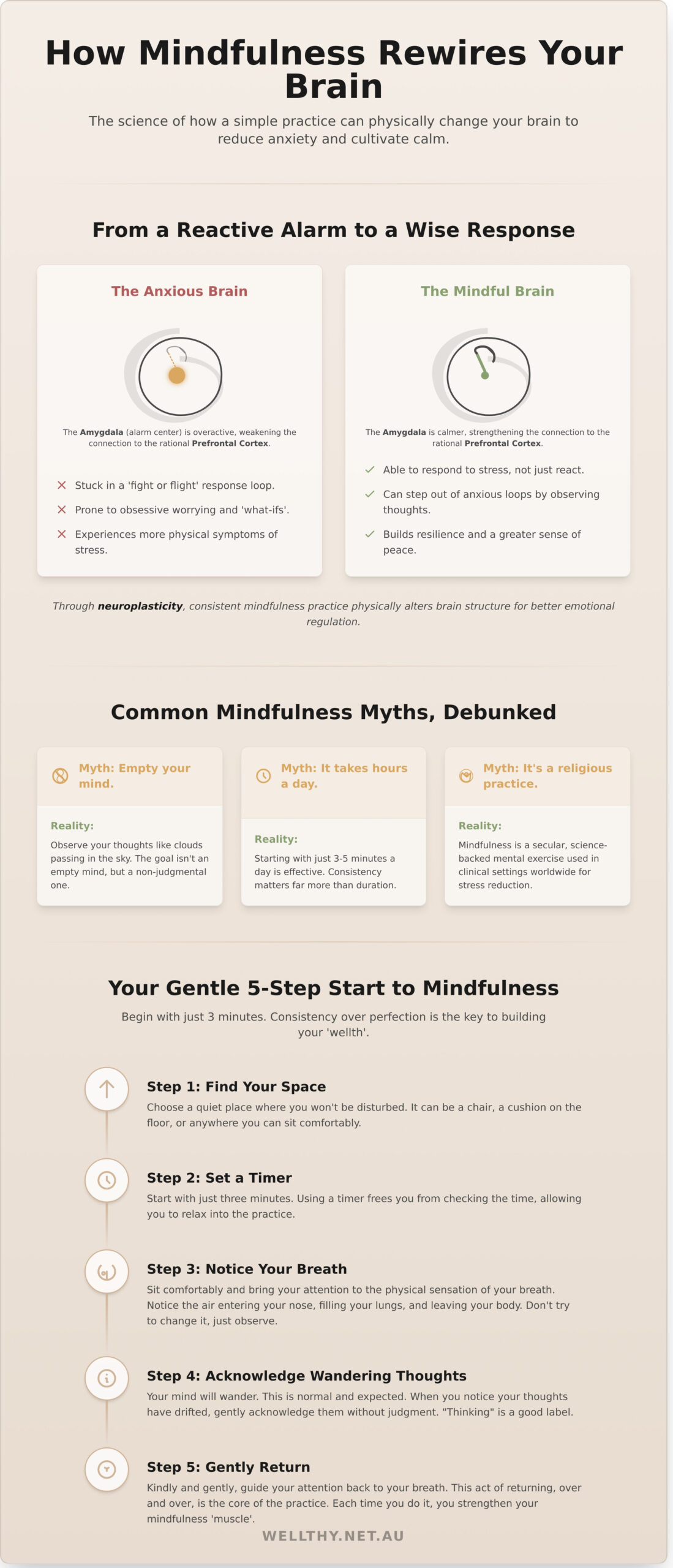
- Myth 1: You have to clear your mind of all thoughts.
Reality: The goal is not to stop your thoughts, but to change your relationship with them. You simply notice when your mind has wandered and gently guide your attention back, without judgment. - Myth 2: It takes hours of practice every day.
Reality: Consistency matters more than duration. You can begin to experience the profound benefits of mindfulness for anxiety by starting with just three to five minutes a day. - Myth 3: It’s a religious practice.
Reality: While its roots are in ancient traditions, mindfulness as a therapeutic tool is a secular, science-backed mental exercise. Its modern applications in healthcare are heavily influenced by evidence-based programs like Mindfulness-Based Stress Reduction (MBSR), which are used in clinical settings worldwide to help people manage stress and improve their well-being.
How Mindfulness Rewires Your Brain: The Science of Calm
It can often feel as though your brain is working against you, stuck in a relentless cycle of worry. But what if you could change its very structure? This isn’t wishful thinking; it’s the science of neuroplasticity. Your brain is not fixed-it is remarkably adaptable, capable of forming new connections and pathways based on your experiences and habits. This is where one of the most profound benefits of mindfulness for anxiety comes into play. Through consistent practice, you can actively retrain your brain for calm. It’s a research-proven way to reduce stress by fundamentally reshaping your neural landscape for the better.
The Amygdala: Your Brain’s Alarm System
Deep within your brain lies the amygdala, a small, almond-shaped set of neurons that acts as your internal alarm system. It’s responsible for the ‘fight or flight’ response, that primal surge of adrenaline and fear that takes over when you perceive a threat. For those experiencing anxiety, this system is often in overdrive, sounding the alarm for threats that are imagined or magnified. Neuroimaging studies show that mindfulness meditation can actually reduce the grey matter density of the amygdala. This physical change corresponds to a tangible feeling: less knee-jerk panic and a greater sense of control when anxious feelings arise.
The Prefrontal Cortex: Your Center for Wise Response
If the amygdala is the alarm, your prefrontal cortex (PFC) is the calm, rational command centre. This is the more evolved part of your brain, responsible for planning, problem-solving, and emotional regulation. Mindfulness strengthens the neural pathways between your thoughtful PFC and your reactive amygdala. This enhanced communication allows your PFC to step in, assess the situation logically, and soothe the amygdala’s overreactions. Instead of being hijacked by an anxious spiral, you create the space to choose a more measured, wise response.
The relationship between these two brain regions is central to understanding the neurological benefits of mindfulness for anxiety. You are creating a more harmonious and integrated brain. Mindfulness practice effectively turns down the volume on the brain’s alarm system and turns up the volume on its calm, logical command center. By investing this time in yourself, you are not just managing symptoms; you are building a more resilient, balanced, and peaceful mind from the inside out.
7 Tangible Benefits of Mindfulness for Anxiety Symptoms
Anxiety rarely feels like a single, simple emotion. It’s a complex experience, often manifesting as a storm of racing thoughts, a pounding heart, and a harsh inner critic. One of the most powerful benefits of mindfulness for anxiety is its ability to provide practical, evidence-based tools that directly counter these specific symptoms. It empowers you to move from feeling overwhelmed by anxiety to actively managing it, creating real, tangible change in your daily life.
From Racing Thoughts to Gentle Observation
For many, the most challenging part of anxiety is rumination-the relentless cycle of obsessive worrying. Mindfulness offers a direct path to break this cycle. It teaches you to become the calm observer of your thoughts, rather than being caught up in them. You learn to notice a thought, such as “What if I fail?”, and see it for what it is: just a thought, not an absolute truth. This simple act of unhooking is profoundly powerful. In fact, a landmark study published in JAMA Psychiatry found mindfulness training to be as effective as medication for treating anxiety disorders, highlighting its clinical strength in rewiring our response to worry.
Calming Your Body’s Stress Response
Anxiety isn’t just in your head; it lives in your body as a clenched jaw, a rapid pulse, and shallow breathing. This is your sympathetic nervous system-your ‘fight or flight’ response-on high alert. Mindful breathing directly activates its counterpart: the parasympathetic nervous system, your body’s innate ‘rest and digest’ mode. By focusing your attention on the gentle rhythm of your breath, you send a powerful signal of safety to your brain. This simple practice can immediately lower your heart rate, ease muscle tension, and calm your entire physical state, guiding you back to a place of balance.
Beyond these immediate effects, a consistent mindfulness practice cultivates other foundational skills for long-term resilience:
- Improved Emotional Regulation: Instead of reacting instantly to an anxious trigger, mindfulness creates a crucial pause. This space allows you to choose your response with greater clarity and less emotional overwhelm.
- Increased Self-Compassion: Anxiety often fuels a relentless inner critic. Mindfulness encourages a kinder, more accepting attitude toward yourself, replacing harsh self-judgment with the gentle understanding essential for healing.
Your First 5 Steps to Starting a Mindfulness Practice (Gently)
Beginning a new wellness practice can feel overwhelming, but the path to mindfulness is paved with gentle intention, not rigid perfection. The goal is consistency, not mastery. Investing just a few minutes each day is a profound act of self-care, building a foundation of inner calm and resilience. This is where you begin to truly experience the sustainable benefits of mindfulness for anxiety.
Here are five simple, actionable steps to guide you.
- Choose Your Time and Space: Dedicate just three to five minutes at a consistent time each day. It could be right after you wake up or before bed. Find a quiet corner where you won’t be disturbed. This simple ritual signals to your mind that it’s time to pause.
- Start with Your Breath: Sit comfortably and bring your awareness to the natural rhythm of your breathing. You don’t need to change it. Simply notice the sensation of the air entering and leaving your body. Your breath is a reliable, gentle anchor for your attention.
- Acknowledge a Wandering Mind: Your mind will wander. This is not a failure; it is the very heart of the practice. When you notice your thoughts have drifted to your to-do list or a worry, gently acknowledge it without judgement and guide your focus back to your breath.
- Practice Informal Mindfulness: Weave moments of awareness into your daily life. Feel the warmth of the water on your hands as you wash dishes. Savour the taste and aroma of your morning tea. These small moments connect you to the present, grounding you when your mind feels scattered.
- Observe with Gentle Curiosity: As you practice, notice thoughts and feelings as they arise. The aim isn’t to stop them, but to observe them without getting entangled. See them as clouds passing in the sky of your awareness-temporary and separate from your core self.
Guided Meditation vs. Unguided Practice
For those new to the practice, a guided meditation can provide an invaluable support structure. Apps like Calm and Headspace offer a reassuring voice to lead you, making it easier to stay present. As you build confidence, you can explore unguided practice, trusting your own breath and awareness to be your guide. Think of it as learning to navigate your own inner landscape with a trusted map.
Troubleshooting: ‘What If I Feel More Anxious?’
It’s quite common to notice anxiety more acutely when you first sit in stillness. If this happens, meet yourself with compassion. Shorten your practice to just one minute, or try a mindful movement exercise like a slow, deliberate walk. This initial amplification is often a sign that you are becoming more aware, which is the first step toward finding relief and unlocking the deeper benefits of mindfulness for anxiety.
Integrating Mindfulness into Your Life for Lasting ‘Wellth’
The true power of mindfulness unfolds when it moves from a timed practice to a way of being. This isn’t about ‘fixing’ anxiety, but about fundamentally changing your relationship with it. By weaving moments of awareness into your day, you begin to make a profound and sustainable investment in your mental ‘wellth’-building a reserve of calm and presence that supports you through life’s challenges with greater vitality.
This practice of integration extends to how you interact with your world. Mindful communication-truly listening without judgment-can soften the sharp edges of social anxiety. Similarly, mindful movement, whether a gentle yoga flow or a simple walk, reconnects your mind with your body, releasing stored tension and grounding you firmly in the here and now.
These skills are especially important for young people navigating challenges like social anxiety or public speaking. Programs designed for teens, such as those offered by SuperMinds, often focus on building this kind of mindful confidence from the ground up.
Mindfulness Beyond the Cushion
You don’t need a quiet room to be mindful. Informal practice integrates awareness into your existing routine, amplifying the benefits of mindfulness for anxiety in everyday situations. Try these simple, powerful actions:
- The One-Minute Breathing Space: Between meetings or tasks, pause. Take three conscious breaths. Notice the sensation of the air entering and leaving your body. This simple reset can calm a racing mind.
- Mindful Eating: At your next meal, put away distractions. Pay full attention to the taste, texture, and aroma of your food. This not only improves digestion but also helps you connect with your body’s hunger and fullness cues.
Building a Sustainable Wellness Routine
Mindfulness is a powerful pillar, but it becomes transformative when integrated into a holistic wellness plan. When you combine your practice with nourishing food, restorative sleep, and joyful movement, you create a synergistic effect that enhances your resilience. Consider adding journaling to your routine; it’s a wonderful way to process the thoughts and feelings you observe during meditation, offering clarity and insight into your unique human experience.
For those seeking professional guidance in developing a comprehensive strategy, a clinic specializing in naturopathic and functional medicine like Holistic Family Practice can be an invaluable resource.
Ultimately, the goal is not to eliminate anxiety, but to build a life so rich and present that anxiety no longer takes centre stage. This consistent, compassionate practice is how you compound the benefits of mindfulness for anxiety over time. To continue building your complete self-care toolkit, explore more holistic wellness guides on Wellthy and invest in your long-term wellbeing.
Your Path to Presence: Embracing a Calmer Future
As we’ve explored, mindfulness is more than a fleeting moment of quiet; it’s a powerful, science-backed tool for reshaping your relationship with anxiety. The key takeaway is simple yet profound: by practicing presence, you can actively rewire your brain for greater calm and resilience. The journey doesn’t require grand gestures, but rather small, consistent steps that build a foundation of inner peace. The evidence is clear-the tangible benefits of mindfulness for anxiety are within your reach, offering a sustainable path to a more balanced life.
Your journey towards lasting ‘wellth’ is a personal one, but you don’t have to walk it alone. Join a trusted community of health-conscious Australians who rely on Wellthy for evidence-based wellness advice and holistic approaches to a balanced life. Ready to take the next step? Discover more ways to invest in your well-being on Wellthy.
The first step towards a more present, peaceful you is simply the next breath you take. You have the power to begin today.
Frequently Asked Questions
Can mindfulness make anxiety worse for some people?
While mindfulness is a powerful tool for most, it can initially heighten awareness of difficult feelings, particularly for those with a history of trauma. The key is to approach the practice with gentle curiosity. If sitting in silence feels overwhelming, start with short, guided exercises. We always recommend consulting a healthcare professional to find a personalised approach that feels safe and supportive, ensuring your path to wellness is a restorative one.
How long does it take to see the benefits of mindfulness for anxiety?
The timeline is deeply personal, as your wellness journey is unique to you. Some people report feeling a sense of calm after their very first session. However, to experience the more profound and sustainable benefits of mindfulness for anxiety, consistency is key. Committing to just a few minutes of practice each day for several weeks can create meaningful shifts in your neural pathways, representing a true investment in your long-term emotional ‘wellth’ and vitality.
What is the difference between mindfulness and meditation?
Think of it this way: mindfulness is the quality of awareness, while meditation is the formal exercise you do to strengthen it. Mindfulness is about bringing non-judgmental attention to the present moment, whether you’re drinking tea or in a meeting. Meditation is the dedicated time you set aside-perhaps 10 minutes in the morning-to specifically train that attention. One is a state of being, the other is the practice that cultivates it.
Do I need an app to practice mindfulness?
No, you absolutely do not need an app. Mindfulness is an inherent human ability that requires nothing more than your attention. While apps can be wonderful tools for providing structure and guided sessions, especially when you’re starting out, they are simply a support system. The core practice of present-moment awareness is always accessible to you, anytime and anywhere, without any technology required for its profound effects.
Can I practice mindfulness while walking or doing other activities?
Absolutely. This is where mindfulness truly integrates into a vibrant lifestyle. You can practice by bringing your full attention to any activity. During a walk, notice the sensation of your feet connecting with the ground or the feeling of the air on your skin. When washing dishes, focus on the warmth of the water. This transforms routine tasks into opportunities for calm presence and helps you find moments of peace throughout your day.
Is there a ‘right’ way to breathe during mindfulness practice?
There is no single ‘right’ way to breathe, which can be a relief to hear. The intention is not to force or control your breath but to simply observe its natural rhythm without judgment. Notice the sensation as the air enters and leaves your body. Some find focusing on the rise and fall of their belly can be a gentle anchor for their attention. The most important part is the curious awareness you bring to the process, not achieving a perfect technique.